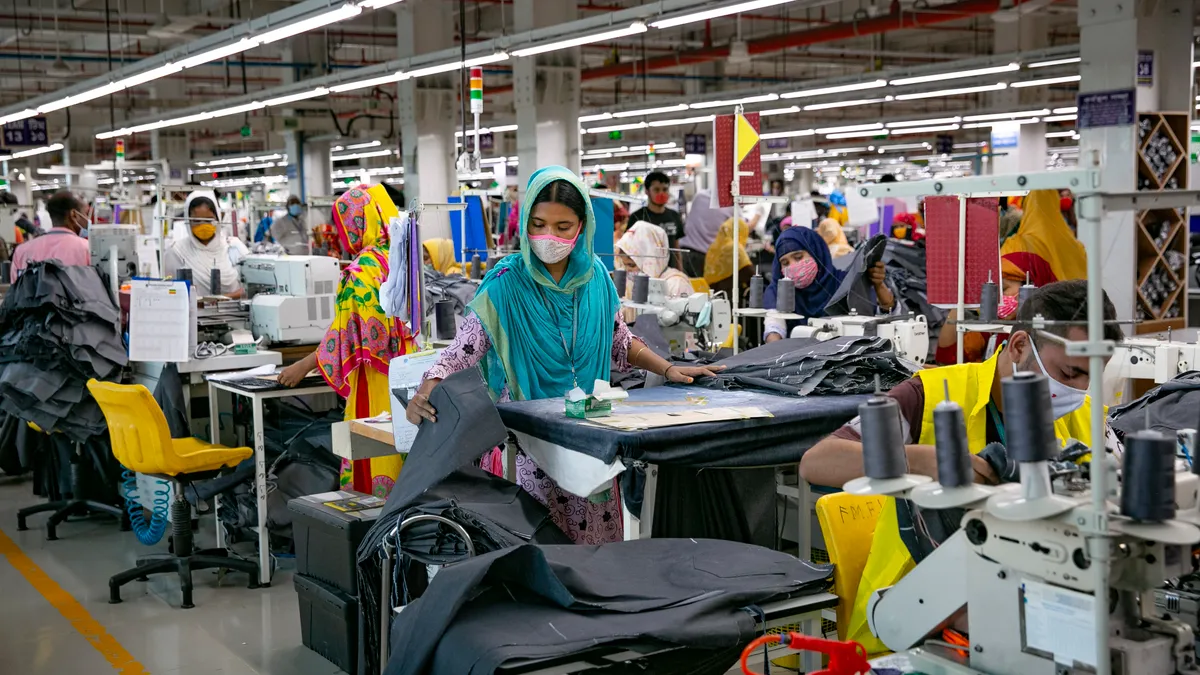
Recent years have seen brands making promises to uphold labor rights and respect a living wage for garment workers. But a new report on the import price of a wardrobe staple, the cotton T-shirt, challenges the seriousness of those commitments.
The report, released last month by Swiss environmental and labor watchdog Public Eye and global nonprofit Clean Clothes Campaign, focuses on cotton T-shirts imported by the European Union — the world’s largest import market for the product — and how their pricing model directly impacts supplier labor conditions.
From 2001 to 2024, the price of this product rose slightly, from $2.15 to $2.67. But accounting for EU and global inflation, the change from $2.15 to $2.67 actually represents a 3.1% decline per year, meaning that the price has fallen by about half in real terms, the report says, raising the question of where these savings come from.
The report focused further on Bangladesh, since 61% of the EU’s T-shirt imports are manufactured there. In 2024, a T-shirt imported from Bangladesh was even cheaper than the average, at just $2.06. About one-fifth of Bangladesh’s cotton T-shirt exports in 2025 were bought by six brands: Bestseller, Primark, H&M Group, Inditex (Zara), LPP, and Fast Retailing (UNIQLO), the report found, based on detailed trade data. Fast Retailing pays the most, an average of $16.95 per kilogram, and LPP pays the least, $10.11 per kg (price per weight is a more accurate comparison, as the weight of t-shirts can vary by brand, the report authors say.) For comparison, In 2025 the average EU import price for cotton T-shirts was $16 per kg, and for T-shirts sourced from Bangladesh, it was just $13 per kg.
For all of the brands, changes in price from 2021 to 2025 translated into real price decreases, when accounting for inflation.
When the brands were presented with the report’s findings, all but Fast Retailing contested the figures.
“The figures you shared in the attached document do not match those in our internal systems,” H&M said in a statement provided to Clean Clothes and Public Eye. H&M pays an average of $12.82 per kg, placing it fourth in terms of price in the group of six, according to the report. Primark, LPP, Inditex, and Bestseller said the report did not take into account variables such as product mix and composition, efficiency improvements, changes in product orders, and cotton price changes.
However, increased productivity is not enough to explain the decline in T-shirt prices, the report says, as there are few skill improvements or technical advancements for T-shirt production. “Instead, an abundance of evidence points to intensified work pressure, higher production targets, neglect of sustainability aspects, or outsourcing to cheaper and even more precarious work settings,” the report said.
To find out how prices are set, the report authors conducted interviews with nine pricing specialists and managers in Bangladesh that work with Global North brands, three from buying houses (intermediaries between brands and factories), and six from medium to large factories specializing in cotton T-shirts. Buyers are “systematically creating a market crisis” by having fixed targets for prices, one interviewee quoted in the report said. “Factory owners here are desperate to survive, so they accept any price,” another said.
These pressures lead to continued low wages for workers, the report said, noting that among major garment manufacturing countries, Bangladesh has the lowest minimum wage, at about $105 per month, while the cost of living for a family in Dhaka is almost four times higher. Those wages represent only 12% of the export price of a T-shirt from Bangladesh, the report found.
Additionally, managers said low prices meant they pressured workers to increase production. “Earlier, our production target was 200 pieces of T-shirts per hour, but now we push the same workers to produce 250 pieces per hour just to stay profitable,” one merchandiser, quoted in the report, said.
If brands are serious about social values, there’s no escaping the need to pay higher prices, the report said. Introducing a minimum price target for T-shirts of about $18 per kg as an interim goal could help, rising to $30 per kg as a medium-term objective to “support a structural transition toward … living wages.”
“The fashion brands which brag about human rights policies actively contribute to the continuation of poverty wages by their downward pricing policy,” Kalpona Akter, president of the Bangladesh Garment and Industrial Workers Federation, said in a press release.
But Bangladeshi merchandisers said that, based on their experience in negotiations, brands were unlikely to pay more to uphold social values. “In fact they often ask for price reductions, saying sales aren’t good,” one interviewee said. “They market sustainability to boost their brand image and profit, but we don’t see the financial outcome of that on our end.”