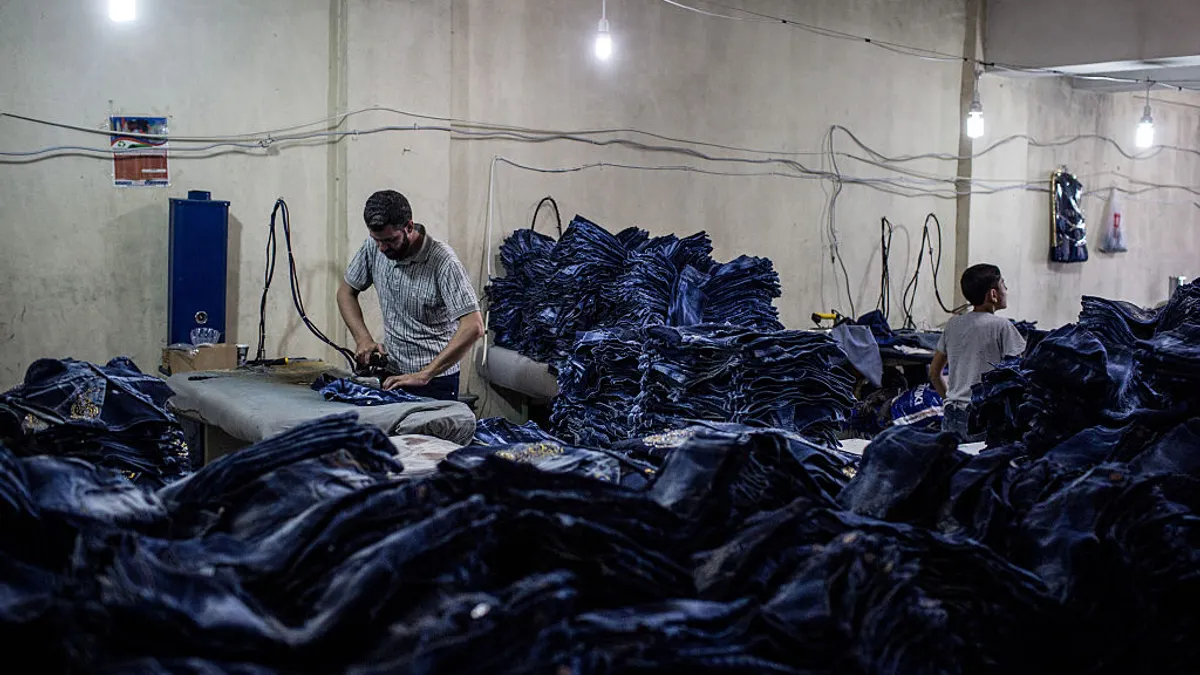
Turkish textile and apparel manufacturer Eroğlu Giyim — which produces garments for fashion companies like H&M Group, Inditex, and PVH — has come under fire for allegedly preventing worker strikes earlier this year, in protest of the manufacturer moving production to Egypt.
Workers at the Turkish supplier, organized under garment workers’ union Öz İplik İş, said the apparel companies “must assume responsibility for these matters,” according to a translation of an August 7 press release from the union. Eroğlu Giyim counts Calvin Klein, Tommy Hilfiger — both owned by PVH — Inditex’s Zara and H&M as clients. All brands have committed to protecting labor rights in their supply chains.
Eroğlu Giyim’s website states its “denim speaks not only of distinctive style, but also of a conscientious choice for a greener planet,” and touts the water-saving aspects of its denim production. Eroğlu Giyim recently closed two factories in Turkey: one in Aksaray in 2025 and a second in Çorlu in 2026, eliminating more than 3000 jobs, the union said in the release.
Eroğlu Giyim’s website says the supplier operates from factories located in Istanbul, Turkey, and Egypt, but on a page describing its supply chain, only a “head office” in Istanbul is mentioned, handling management, sales and marketing, supply chain, design, and R&D. According to the page, all production occurs in the Suez Canal Economic Zone and Ismailia, both in Egypt.
The factory closures represent “structural problems facing Turkey’s textile and ready-to-wear sectors,” the union said in the press release.
“Companies that manufacture in Turkey and then move their investments and production to other countries must fulfill their responsibilities toward workers and their union rights during this process,” Öz İplik İş President Rafi Ay said.
The garment workers’ union said they began collective bargaining discussions at Eroğlu Giyim’s factory in Avcılar, a district of Istanbul, but that they were subsequently prevented from communicating with workers there and that “channels of dialogue with the employer had closed.”
The union launched a strike at the Avcılar factory on April 30 to protest the closures, but workers were “threatened with dismissal” if they participated, according to the press release.
“Strikes and union activities are rights guaranteed by the Constitution and the law,” Ay said in the release. “It is unacceptable to intimidate or deter workers from exercising these rights.”
Notably, H&M, Inditex, and PVH have all signed Action, Collaboration, Transformation (ACT), an agreement meant to protect apparel workers’ rights, with IndustriALL Global Unions, of which Öz İplik İş is also a member.
“As clearly stated in our Sustainability Commitment that all our suppliers must sign and comply with, freedom of association and the right to collective bargaining must be recognized and respected,” an H&M spokesperson told ESG Dive Tuesday . “Together with other brands we are in consistent communication with Öz İplik İş about this case. We are in touch with management to ensure that they understand our expectations on freedom of association and encourage a solution-oriented dialogue.”
Tommy Hilfiger and Inditex did not respond to requests for comment as of press time.
This is not the first time global brands’ messaging about ethical supply chains has contrasted with the reality in factories that produce garments for them. In 2020, H&M’s supplier closed a heavily unionized factory in India that sewed for the company. At the time, workers alleged the factory was closed in order to dissolve the union.
In 2021, another Indian H&M supplier made headlines when a garment worker named Jeyasre Kathiravel was raped and murdered by her supervisor, leading female workers to come forward about how they had been sexually assaulted, harassed and verbally abused by their managers.
According to a 2025 report by Amnesty International, of the 269 factories that sewed for H&M in Bangladesh, India, Sri Lanka, and Pakistan, only 37 had unions. Information for Inditex and PVH was not available, per the report.
The report looked into the supply chains at 21 brands, all of whom “had codes of conduct for suppliers, human rights policies or principles, which affirmed the company’s commitment to workers’ right to freedom of association,” Amnesty said in a press release. Despite that messaging, the report found “very few independent trade unions” in brands’ supply chains in those four countries.
Earlier this year, Öz İplik İş called for global brands to “not turn a blind eye to these human rights violations in [their] supply chains any longer”
“Remaining silent in the face of practices that disregard workers’ right to organize and their right to collective bargaining is not neutrality — it is complicity in injustice.” the union said in a June 4 press release publicizing the strike at the Avcılar factory.
The union did not respond to a request for comment as of press time.