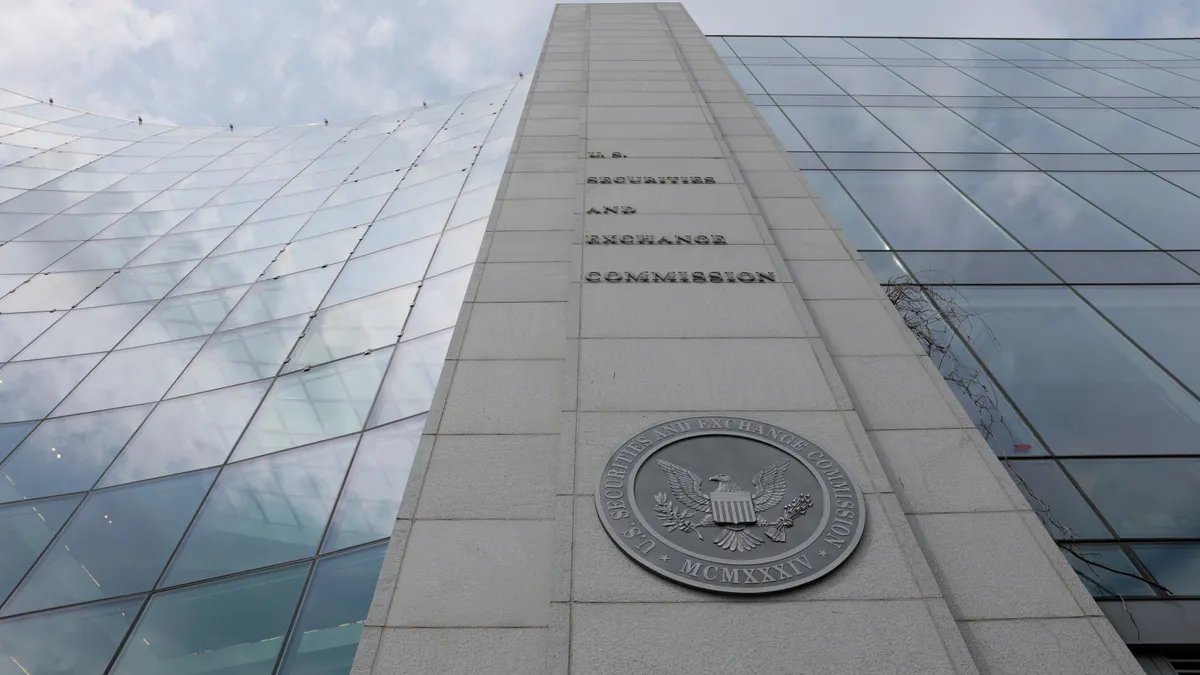
The Securities and Exchange Commission has signaled it will propose changes to an agency rule governing the shareholder proposal process this year, spurring pushback from a coalition of investor advocates who are asking for any alterations to “largely retain the rule” after an unusual proxy season.
Close on the heels of a speech where SEC Chair Paul Atkins hinted at more wholesale changes to Rule 14a-8 — which governs the shareholder proposal process — a group of investor advocates filed a regulatory petition with the agency, pushing for any alterations to be narrower and not include the complete rescission of the rule, according to a press release and the petition shared with ESG Dive.
The SEC decided in November to sit out the bulk of the no-action process during the 2025-26 proxy season, citing the monthlong government shutdown as the reason at the time. At a corporate governance conference earlier this month, Atkins said “the staff’s absence this season did not create the chaos that many feared,” and, beyond the agency’s role in the process, “the SEC is also holistically evaluating the rule itself.”
In a July 23 petition addressing the SEC, the investor advocates asked the agency to immediately reinstate the no-action process and consider implementing a mandatory two-week engagement period after companies issue an exclusion notice, along with other tweaks to the exclusion process. The coalition includes investor groups Ceres, the U.S. Sustainable Investment Forum, the Interfaith Center on Corporate Responsibility, the Shareholder Rights Group and For the Long Term, as well as New York State Comptroller Thomas DiNapoli.
“The right to file a shareholder proposal that appears on the corporate proxy statement is not a courtesy extended by management. It is a foundational aspect of corporate ownership,” the petition says. “This voice is also a source of market efficiency. … Curtailing that voice weakens one of the few mechanisms through which dispersed owners can hold management to account.”
In addition to suggesting changes that would potentially streamline the exclusion of shareholder proposals before it reaches the SEC, the petition asks that, if the agency is considering larger changes to the process, it should “also evaluate alternatives that maintain the federal rules while eliminating the no-action process.”
The petition said that “outright rescission of Rule 14a-8 would upset a longstanding balance between investors and their companies.”
In the latest federal regulatory agenda, the SEC said it plans to propose “amendments to modernize certain rules regarding the proxy solicitation process, including certain filing and procedural requirements relating to proxy solicitations and shareholder meetings, to reduce costs and compliance burdens,” with plans to propose amendments by October.
Atkins noted in a speech July 9 at the Society for Corporate Governance Conference that six lawsuits arose from the lack of staff review, but said “they represent but a small fraction of the overall proposals excluded.” Atkins said his “greatest takeaway is that the Commission staff’s interposition between companies and shareholder proponents is unnecessary to effectively and efficiently resolve whether shareholder proposals should be included in proxy statements.”
However, the percentage of challenged shareholder proposals that didn’t make it to a proxy statement jumped from 50% in 2025 to 82% in 2026, Beth-ann Roth, the Interfaith Council on Corporate Responsibility’s general counsel, said on a press call Thursday morning.
In addition to filing the regulator petition, the Shareholder Rights Group and nonprofit legal group Democracy Forward filed a Freedom of Information Act request “seeking correspondence and calendar entries regarding previewing of the Commission's 14a-8 rulemaking plans to external entities,” Shareholder Rights Group Director Sanford Lewis said Thursday. Lewis said the coalition also delivered additional petitions with over 32,000 signatures to the agency from investment firms, investors and beneficiaries that also urged the SEC to retain Rule 14a-8.
“This rule has been called a cornerstone of U.S. corporate governance and engagement,” Lewis said on Thursday’s press call. “If the SEC considers radical measures that would essentially remove that cornerstone, it's imperative under the Administrative Procedure Act that they also consider alternatives less harmful to the market.”