
Dive Brief:
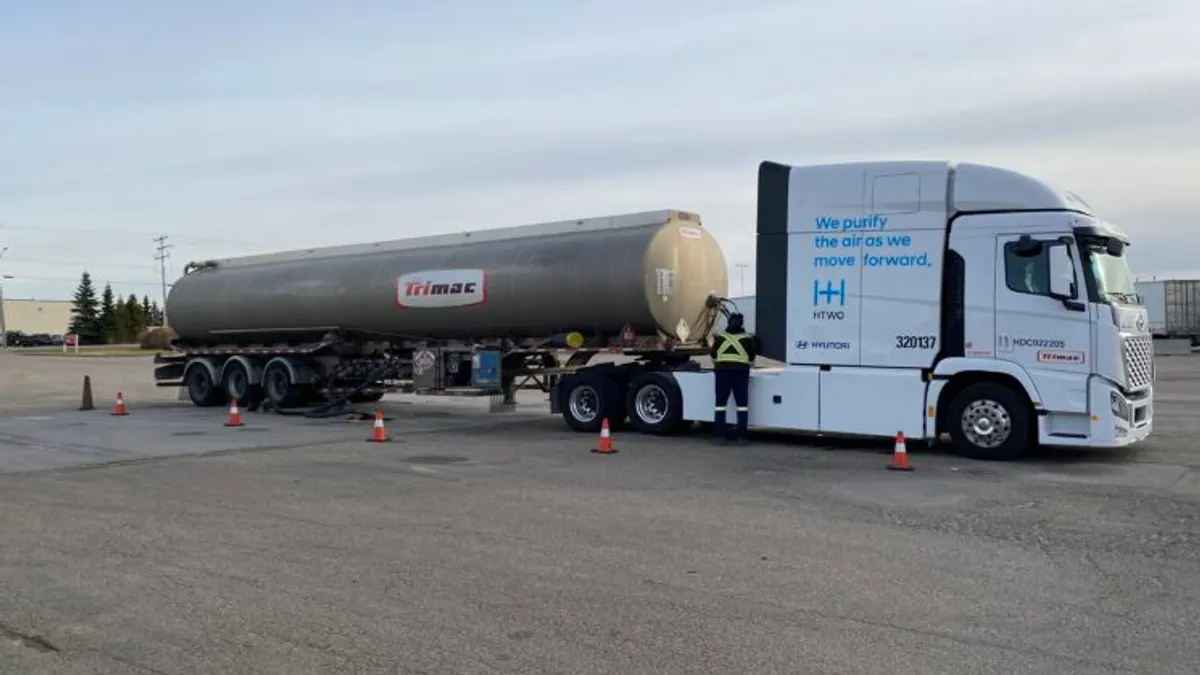
- Trucking services provider Trimac is participating in a regional pilot of a hydrogen fuel cell truck in Western Canada to assess the technology's effectiveness across a range of driving conditions, the bulk transport carrier announced in a press release.
- The pilot is spearheaded by the Alberta Motor Transport Association and is designed to help carriers build operational knowledge of hydrogen systems, per the Dec. 9 release.
- “We aim to understand how this solution performs under real-world conditions and what will be required to make it practical at scale,” Abe Masri, manager of energy transition and sustainability with Trimac, said in a statement.
Dive Insight:
Adoption of hydrogen fuel cell technology has faced hurdles, as early pioneers, including Nikola and Hyzon, have shuttered operations.
However, the technology’s advancement continues through other companies such as Lucid, which acquired Nikola’s assets and offered jobs to more than 300 of the company’s former employees.
Automotive giant Hyundai has also invested heavily in hydrogen fuel cell technology. The company announced plans to open a Class 8 hydrogen production and dispensing facility near the Port of Savannah, Georgia.
The vehicle being used in AMTA’s pilot is a Hyundai XCIENT hydrogen fuel cell truck. The tractor will be rotated among participating fleets to give each company an opportunity to assess its performance in real commercial conditions, AMTA said in the release.
Trimac said its participation in the pilot aligns with its sustainability commitments, which focus on fleet modernization, fuel-saving technologies and exploration of zero-emission alternatives. Trimac is also a stakeholder in the Alberta Zero Emission Truck Electrification Collaboration, which is preparing a hydrogen fuel-cell prototype for commercial testing.
Trimac said its evaluation of Hyundai’s hydrogen fuel cell technology will continue through early 2026.
While Trimac advocates for zero-emission technology, it acknowledges partnerships are needed for widespread adoption.
“We recognize that hydrogen adoption requires a broader ecosystem of infrastructure and collaboration,” Masri said. “This initiative supports the foundational efforts needed to enable future zero-emission options for the industry.”