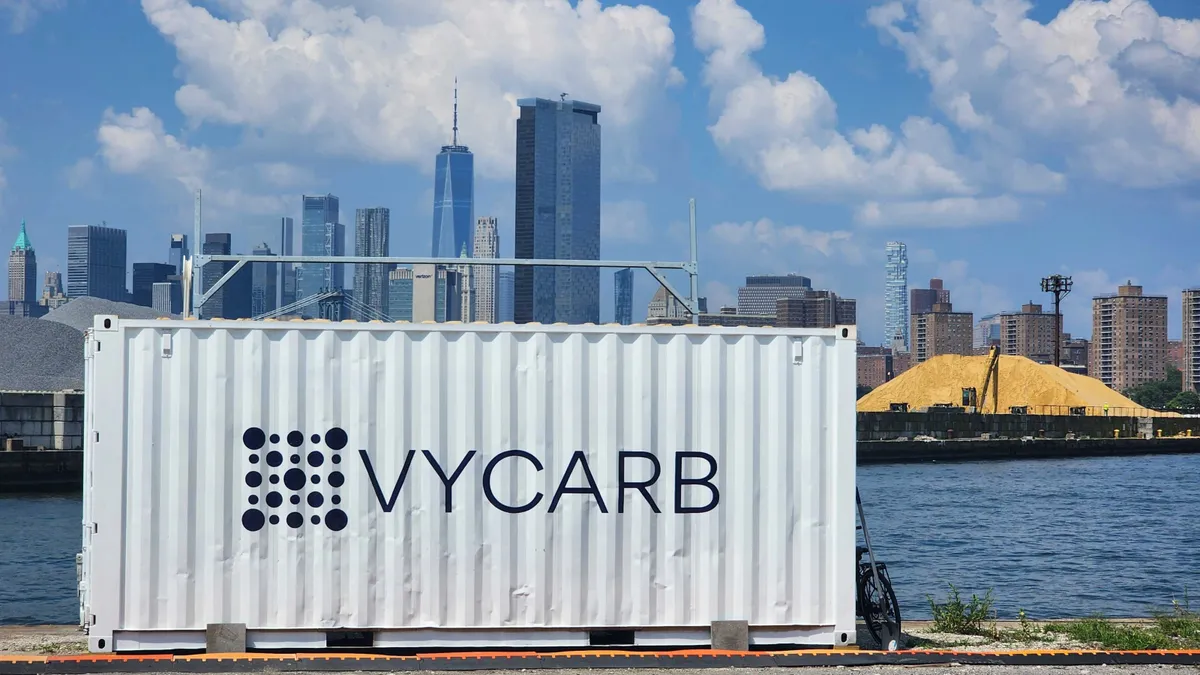
After growing its partnerships and funding last year, carbon removal startup Vycarb is gearing up to scale its business in 2026. The company, founded in 2022, has been piloting carbon removal in New York City’s East River and is looking to expand from pilots to commercial applications this year.
“Vycarb’s priority in 2026 is scaling, from pilots to commercial deployments, by expanding its international project pipeline and accelerating the commercialization of its low-cost, fully measurable carbon capture and storage technology,” Vycarb CEO Garrett Boudinot told ESG Dive.
To prepare for that next step, the startup has partnered with industrial CO2 management company Tomco Systems and expanded its partnership with ocean climate solutions monitoring company atdepth. These partnerships have allowed Vycarb to further develop the testing and verification of its ocean-based carbon removal method, according to releases shared exclusively with ESG Dive. The details of Vycarb’s partnership with Tomco and atdepth have not been reported on previously.
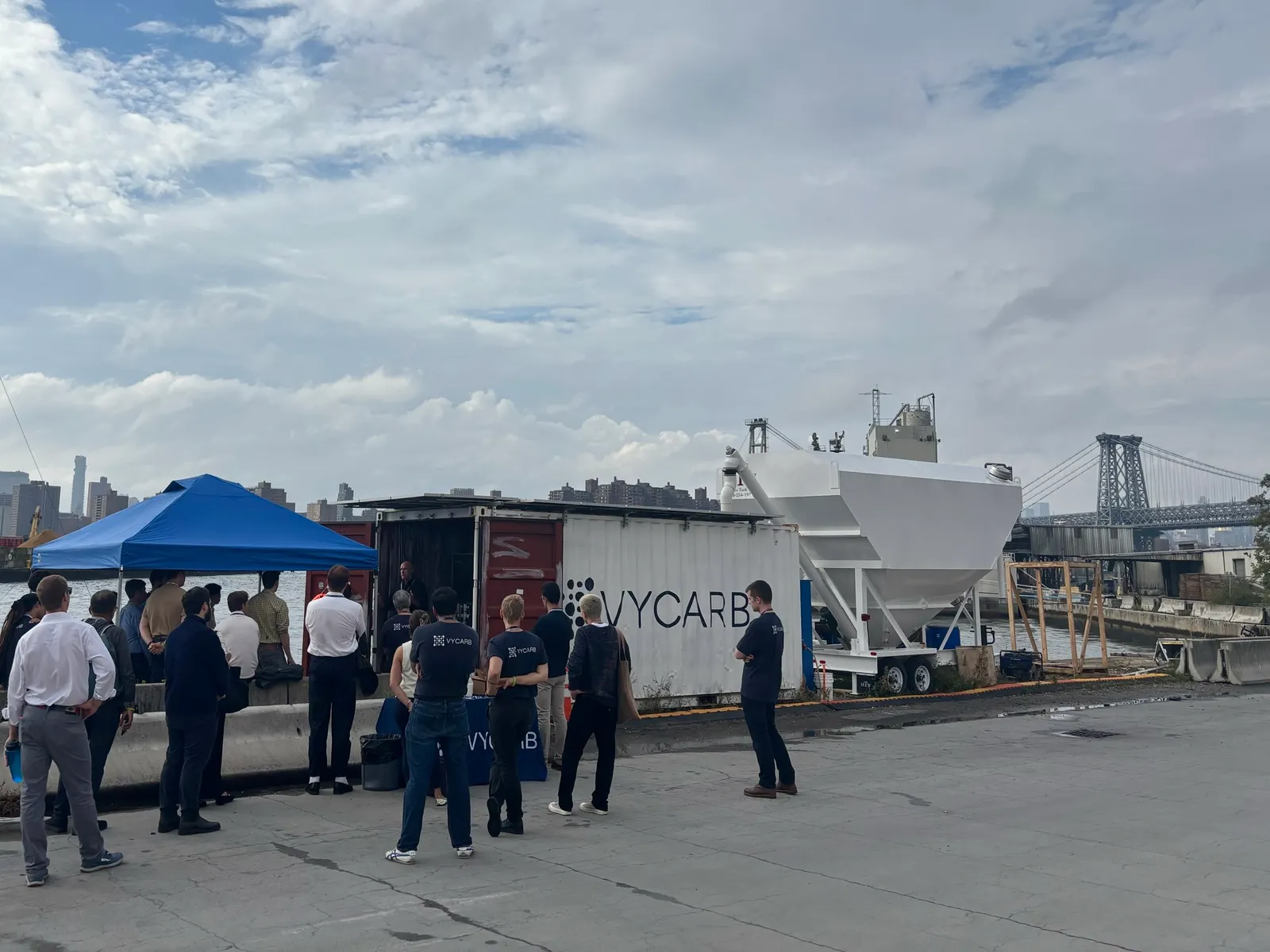
Vycarb’s initial solution focused on removing carbon dioxide that was already present in water, but its partnership with Tomco allows the company to take industrial carbon dioxide gas as an input and convert it into bicarbonate that’s able to be stored in the water, Boudinot said in an interview.
“While there are lots of waters that have high CO2 [or] that emit CO2 that are an opportunity for removing and storing carbon, there's also lots of CO2, not in water, but in the atmosphere that's coming out of point source emissions that we've realized our technology can be a permanent storage solution for,” Boudinot said.
With the industrial gas integration, Vycarb is able to test the efficacy of its storage with different purities of carbon dioxide, including “really low purity” carbon dioxide. Its ability to convert and store different purities of CO2 separates Vycarb from other decarbonization efforts being adopted in hard-to-abate industries and carbon removal technologies, which Boudinot said typically require high-purity CO2 gas to be transported in pipelines or for geologic storage.
In order to ensure the efficacy of the removals, atdepth is charged with independently monitoring the East River to confirm the success. After running the East River pilot for over a year, Vycarb’s CEO said the company has “a lot more independent confidence that … there are no negative impacts of this, especially in places like the East River.”
“We're not able to detect [an] ecosystem rebound, but we're at least seeing that plume of hot, slightly higher pH water that's de-acidified is mixing with the rest of the river, and that just gives us confidence of the long term benefits,” Boudinot said.
The deal also allows atdepth, which spun out of MIT and is backed by Google and the National Aeronautics and Space Administration, to scale its own operations based on what’s learned at the pilot site. This includes observing what technical equipment and monitoring strategies work best, and atdetpth CEO and Co-Founder Carlos Muñoz-Royo said the company is primarily working to ensure its approach is “operational and scalable.” The company mixes ocean monitoring with ocean modeling, to understand as much of the pilot’s impact as possible.
“The ocean is huge, and even when we talk about small pilot projects, anything that is affecting the properties of the ocean water, even a marine CDR project, ... if we are removing dissolved CO2 from that water, ocean currents are going to take that water away from the product site and may travel hundreds of kilometers,” Muñoz-Royo said in an interview. “We need to be tracking that water for that long, so we need the ability to understand what happens there.”
Plans to scale
The expanded partnerships came shortly after Vycarb completed a $5 million funding round in October, led by climate tech investment firm Twynam. That funding round included participation from venture capital firms, sustainable aquaculture investment firm Hatch Blue and the Singapore government. Vycarb told ESG Dive that energy giant Shell also participated in that funding round, which has not been previously disclosed.
The startup is using that funding to expand its team and advance system and is now looking to integrate its technology at industrial and larger-scale sites where the operations emit high levels of carbon dioxide near water, Boudinot said. The Vycarb CEO said the startup is best suited at this point to work with companies and partners in hard-to-abate sectors and industries or with “some urgent need to decarbonize or for carbon storage.”
“A lot of companies have net-zero targets, and, frankly, a lot of the companies that we talked to with those kinds of targets are interested in learning about our technology … maybe one day in the future,” Boudinot said. “That's great, but that's obviously not where we're putting a lot of our effort. We're really focused on the groups that have an urgent need for this solution.”
While unable to disclose specific deals, Boudinot said the company has lined up a pipeline of partnerships and projects in the U.S., Europe and Asia Pacific regions and hopes to be able to announce them in the next year. He added that the current administration’s stance against climate incentives has forced the company to look outside U.S. borders and leverage its existing international partnerships and investors.
“The U.S. is not the world, and there's still very active and growing decarbonization mechanisms elsewhere in the world,” Boudinot said. “So leveraging them and continuing to work with the partners we've already made has been a really useful buffer against some of the uncertainty or volatility in the U.S.”