
Dive Brief:
- President Donald Trump is calling for a “reset” of the current Corporate Average Fuel Economy (CAFE) standards put in place by the Biden administration requiring that automakers achieve average fuel economy of 50.4 miles a gallon by 2031, according to a White House fact sheet.
- The Trump administration claims that the current Biden-era standards have imposed “unrealistic fuel economy targets” on automakers that would raise the average price of a new vehicle by nearly $1,000, as well as costing American consumers an additional $109 billion a year through 2031.
- The White House fact sheet also claims that the current Biden-era standards would result in a widespread shift to more expensive electric vehicles in the U.S. that consumers did not ask for, even though EV sales in the U.S. have grown year over year.
Dive Insight:
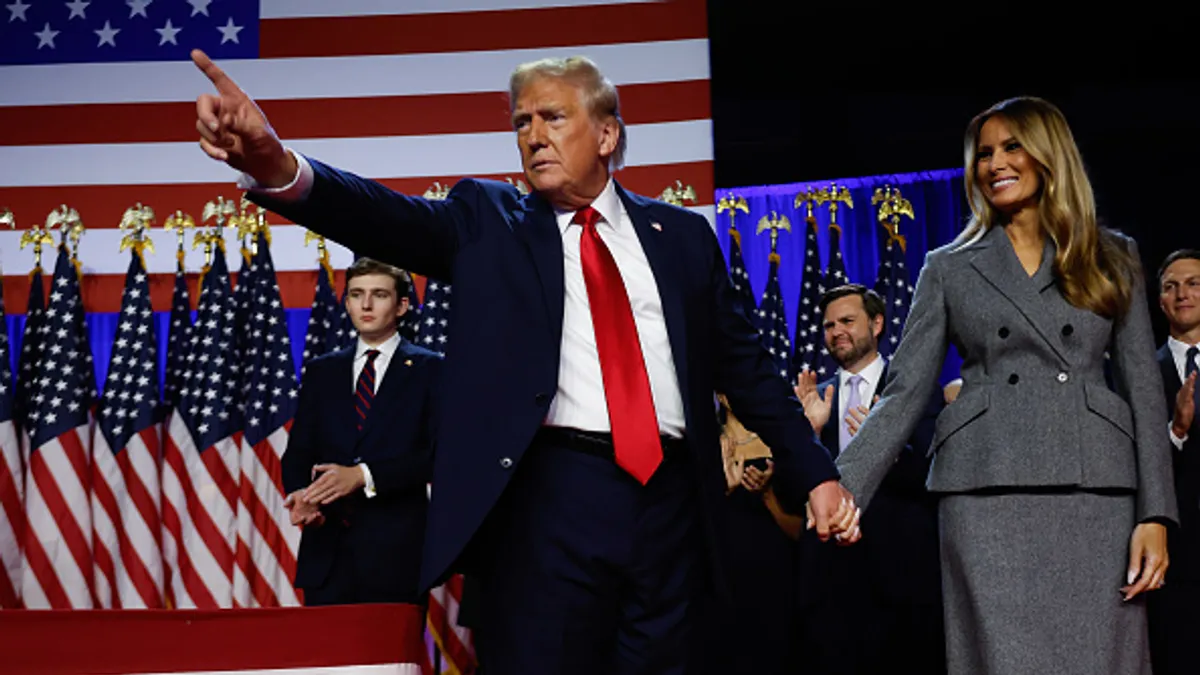
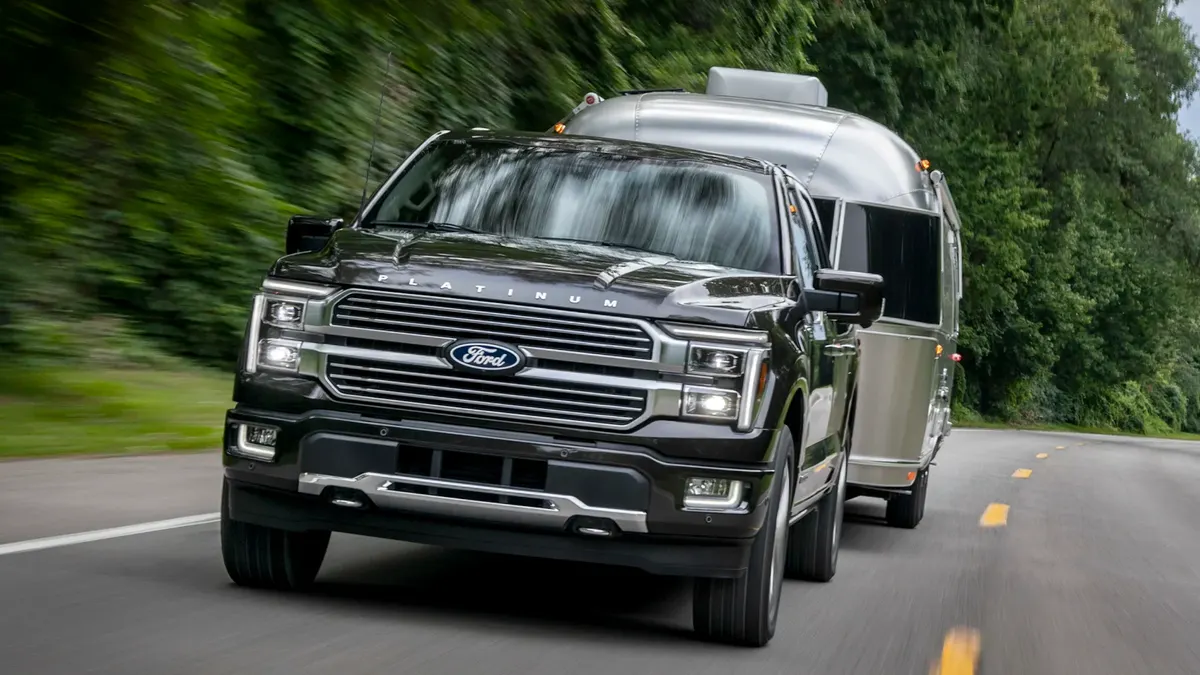
The plans were announced at a White House event attended by Ford Motor Co. CEO Jim Farley and Stellantis CEO Antonio Filosa. Ford, along with rival General Motors, currently rely on the U.S. sales of gas-powered trucks and SUVs for a majority of their profits and say they have yet to make money on low-volume EVs.
The fact sheet released by the White House on Wednesday further claims that OEMs would have to raise the price of their gas-powered models in order to make up for the losses on EVs if the current CAFE standards were left in place. These higher vehicle costs would then lead to significant cost-of-living increases for consumers.
According to the release, lowering CAFE standards is a sensible move, so automakers are “not held to infeasible standards,” a sentiment shared by Farley, whose company lost billions on EVs like the Ford F-150 Lightning over the past several years.
Ford's Model e EV division lost $5.1 billion in 2024, which followed a loss of $4.7 billion in 2023.
"As America's largest auto producer, we appreciate President Trump's leadership in aligning fuel economy standards with market realities,” Farley said in a statement. “We can make real progress on carbon emissions and energy efficiency while still giving customers choice and affordability. This is a win for customers and common sense.”
But environmental groups and others have criticized the rollback of fuel economy standards, as global automakers, including China's auto giants BYD and Geely, aggressively ramp up production and exports of EVs to Europe and other global markets.
“We’ve seen this movie before when President George W. Bush’s weak standards allowed Detroit to ignore technology and churn out gas-guzzling clunkers,” said Dan Becker, director of the Center for Biological Diversity’s Safe Climate Transport Campaign, in an emailed statement. The group’s efforts are focused on reducing greenhouse gas emissions from the transportation sector.
“The result was bankruptcy for two of the Big Three and an $80 billion bailout paid for by taxpayers,” Becker said, referring to the U.S. government's 2009 financial rescue package to prevent the collapse of the auto industry during the Great Recession.
The Trump administration also claims that the Biden-era standards broke the law by going far beyond the requirements mandated by Congress when the CAFE program was enacted in 1975. The revised standards, which were announced in April 2022, call for an industry-wide fleet average of approximately 49 miles per gallon for model year 2026 passenger cars and light trucks, with incremental improvements through 2031.
The plans to gut CAFE standards had been discussed since January, shortly after President Trump’s inauguration. In June, Trump signed a joint resolution to end California's more stringent emissions mandates that have been in place for decades. The state’s emission reduction efforts also call for the phasing out of the sales of new internal combustion engine vehicles by 2035. Over the years, 17 states have adopted California’s more strict emissions requirements.
Then in July, President Trump signed into law the Working Families Tax Cut Act, which lowered the civil penalty for violating CAFE standards to $0, a preliminary move the administration said was to protect automakers building vehicles in the U.S. from any significant fuel economy fines.
Since CAFE requirements were first signed into law in 1975, they have reduced American oil consumption by 25%, equal to roughly five million barrels of oil per day, according to the National Highway Traffic Safety Administration. At the time, the new fuel economy requirements were intended to strengthen U.S. energy independence and help reduce the country’s reliance on fossil fuels.
In addition to weakening requirements pushing automakers to produce more fuel efficient vehicles, Becker also worries that U.S. automakers like GM and Ford may lose their competitive edge and be left behind in the global technology race as the rest of the auto industry continues to move towards full electrification.
Global EV sales topped 17 million units in 2024, a year-over-year increase of 25%. EVs accounted for about 20% of all new light-duty vehicles sold worldwide in 2024, according to the International Energy Agency.
“Trump’s action will feed America’s destructive use of oil, while hamstringing us in the green tech race against Chinese and other foreign carmakers. The auto industry will use this rule to drive itself back into a familiar ditch, failing to compete,” Becker said.