Dive Brief:
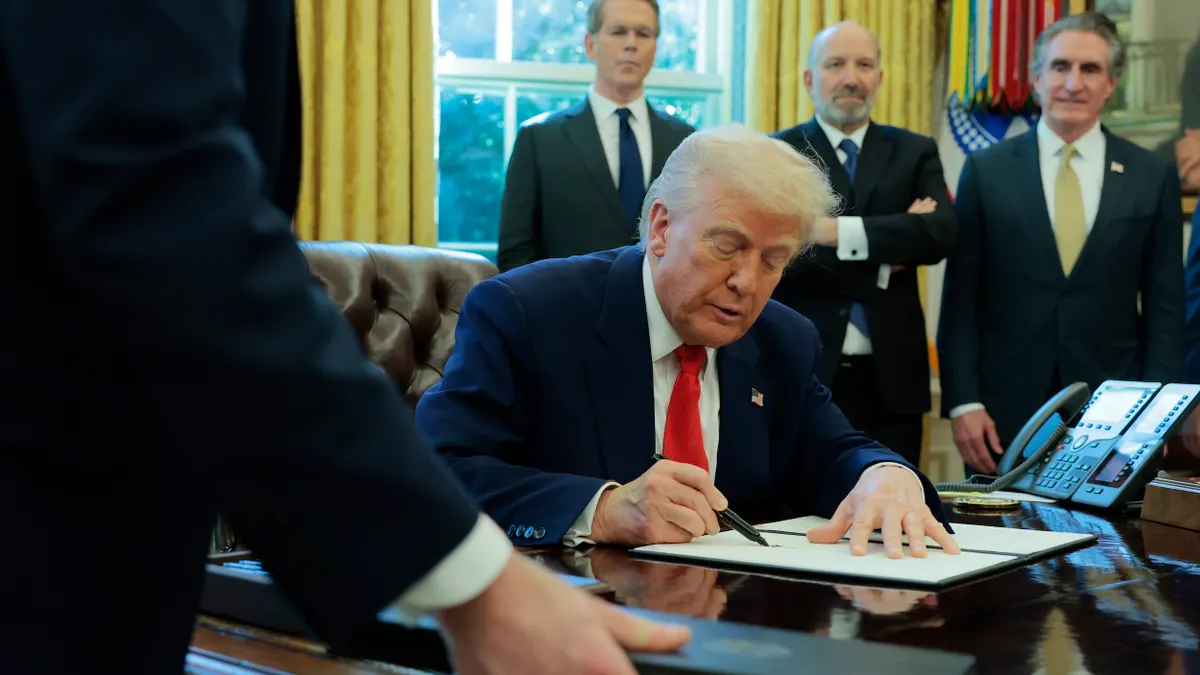
- President Donald Trump has withdrawn the United States from a key climate agreement that some consider the bedrock of all international efforts to limit global warming, the White House announced Wednesday.
- The U.S. will exit the United Nations Framework Convention on Climate Change, along with 65 other international organizations, according to a Jan. 7 executive order. These include a slate of agencies, bodies, commissions and groups focused on climate, clean energy, sustainable development, gender equality and other issues the Trump administration finds “contrary to the interest of the United States,” the order said.
- Most of the organizations named in the order fall under the United Nations, including its leading climate science body, the Intergovernmental Panel on Climate Change; a UN program on reducing emissions from deforestation and forest degradation in developing countries; and UN agencies focused on energy, water, oceans and human settlements, among others.
Dive Insight:
The decision to pull the U.S. out of the cadre of organizations aligns with other executive orders Trump signed last year that aimed to reverse federal climate policies and precedents set by his predecessor.
Trump started his second term last January by signing an order that withdrew the U.S. from the Paris Agreement for a second time. The global agreement, adopted in 2015, seeks to combat climate change by limiting global warming and requires participating countries to submit emission reduction plans that outline how they plan on curbing their footprint.
In March, Trump’s administration pulled the U.S. from the board of a UN-backed climate damage fund designed to provide financial assistance to nations most vulnerable to climate change. On the same day, a representative from his administration condemned the sustainable development goals set by the United Nations and its global framework to achieve these goals by the end of the decade. The SDGs include goals of ending poverty, attaining gender equality and taking urgent climate action.
Simon Stiell, the UN’s climate chief and executive secretary of the UNFCCC, said the U.S. decision to depart will ultimately impact its own people and economy.
“While all other nations are stepping forward together, this latest step back from global leadership, climate cooperation and science can only harm the U.S. economy, jobs and living standards, as wildfires, floods, mega-storms and droughts get rapidly worse,” Stiell said in a Thursday statement. “It is a colossal own goal which will leave the U.S. less secure and less prosperous.”
The UNFCCC is responsible for hosting the UN’s landmark annual climate summit each year, whose primary goal is to address climate change. Trump did not send an official delegation to the summit’s latest iteration held in Brazil in November, a move that was criticized both on home territory and abroad.
At the time, California Gov. Gavin Newsom called the Trump administration’s absence at COP30 an “abomination” and a “disgrace,” and criticized the president for allowing China, a major U.S. economic and political rival, to have an unobstructed opening and influence at a global stage such as the summit.
Trump’s Wednesday order also lists exits from the International Energy Forum, International Solar Alliance, International Renewable Energy Agency and the International Union for Conservation of Nature among the 66 organizations the U.S. will exit.