Dive Brief:
- United Nations Secretary-General António Guterres proposed a framework for artificial intelligence companies to disclose their impacts as part of the UN’s plan for global energy independence.
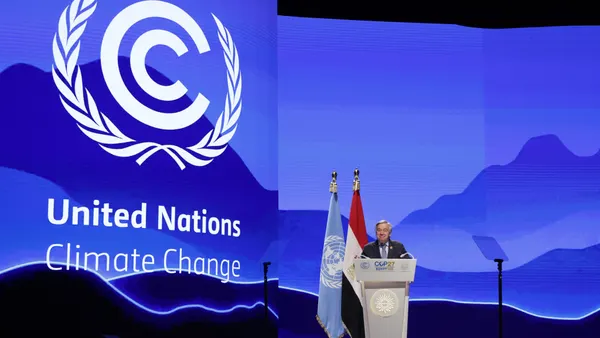
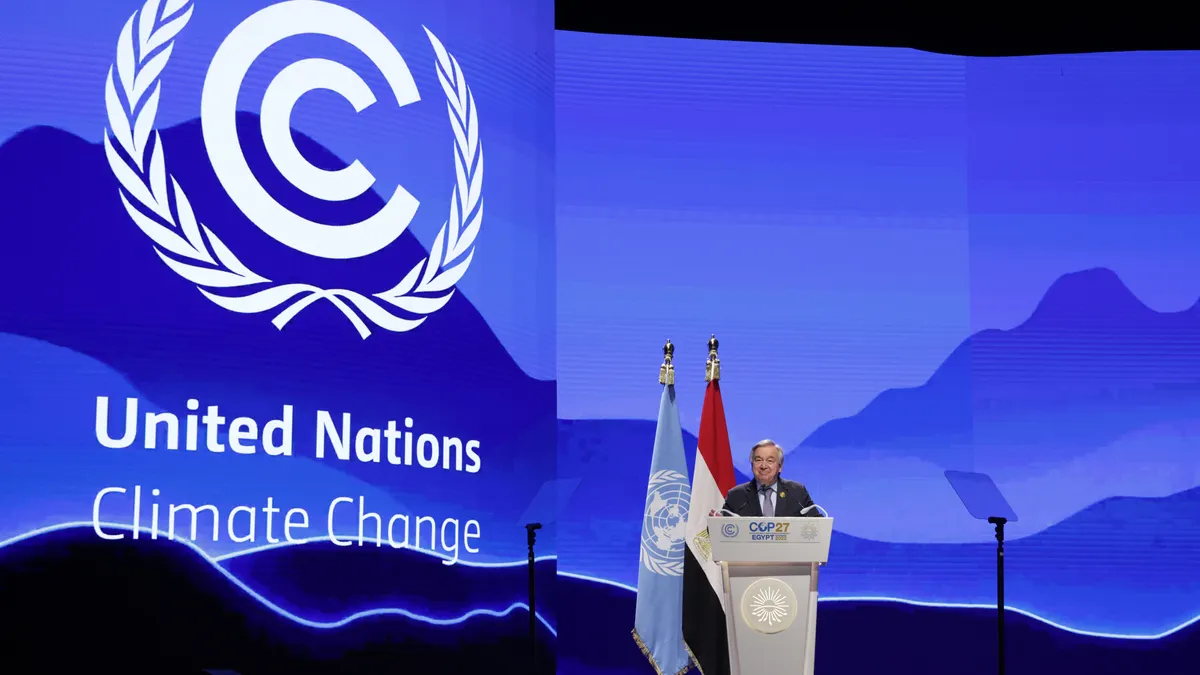
- In a London Climate Action Week keynote on Tuesday, Guterres called on “every major AI company” to measure and publicly disclose their full environmental footprint, including emissions, water and land usage. The UN chief also called on AI companies to commit to powering every data center with renewable energy by 2030.
- “No more hidden costs. No more shifting the burden onto those least able to bear it,” Guterres said, according to the UN transcript. “It is time to come clean. If AI is to help build a better future, it must be honest about what it costs us now.”
Dive Insight:
Guterres issued the call for AI companies to disclose their environmental impacts and commit to powering data centers with renewables as part of a seven-point plan for energy independence.
In the United States, data center electricity consumption is projected to grow 300% over the next 10 years and account for “38% of net electricity consumption through 2037,” according to the National Electrical Manufacturers Association.
Guterres said that, globally, AI has the potential by 2030 to use more power than “all but five countries” and “enough water to meet the basic needs of all 1.3 billion residents of sub‑Saharan Africa for an entire year.”
“As demand for energy continues to rise, we must confront one of its fastest growing sources: AI data centers,” Guterres said. “Artificial intelligence can accelerate climate solutions. It can help cure disease, transform education, and enable humanity to tackle challenges once thought beyond our reach. We must harness that potential.”
“But AI is also hungry for land, water and power,” he added.
The UN’s secretary general said that, in order for a global break from fossil fuels, global greenhouse gas emissions “must peak immediately, fall steeply this decade and reach global net-zero by 2050.” He called on G20 countries to lead the transition, as they are responsible for 80% of global emissions.
Guterres’ plan also calls for the promotion of clean energy projects and the elimination of public fossil fuel subsidies; developing clean energy projects in a way that benefits workers and communities; and help for those most at risk from climate change adaptation.
The official also called for financial support for “scientific independence” to be protected and for the global transition from fossil fuels to increase with “scale, speed and fairness." Guterres said countries "rich in renewable potential are being locked out of the clean energy revolution," noting that developing nations' clean energy borrowing costs can be twice or three times that of wealthier nations.
“Energy independence cannot be built on fossil fuel dependence,” Guterres said. “Renewables are the cornerstone of true energy security. … The more economies run on clean electricity, the more secure, resilient and competitive they become.”
While the Trump administration has pulled the U.S. from global climate treaties and organizations, the UN’s ask for AI companies to commit to broad environmental disclosures and clean energy for data centers comes amid calls for a national data center moratorium and increasing local input.
Earlier this month, 520 national, regional and local organizations across 47 states and the District of Columbia signed a letter urging Congress to pass a national moratorium, citing their electricity and water use. The June 11 letter, led by nonprofit Food & Water Watch, also cited impacts on Indigenous lands, rising electricity costs and job losses as a reason to halt data center construction.
Increased local pushback and issues with access to power caused a spike in U.S. data center project cancellations last year, to 25, from six the year prior.