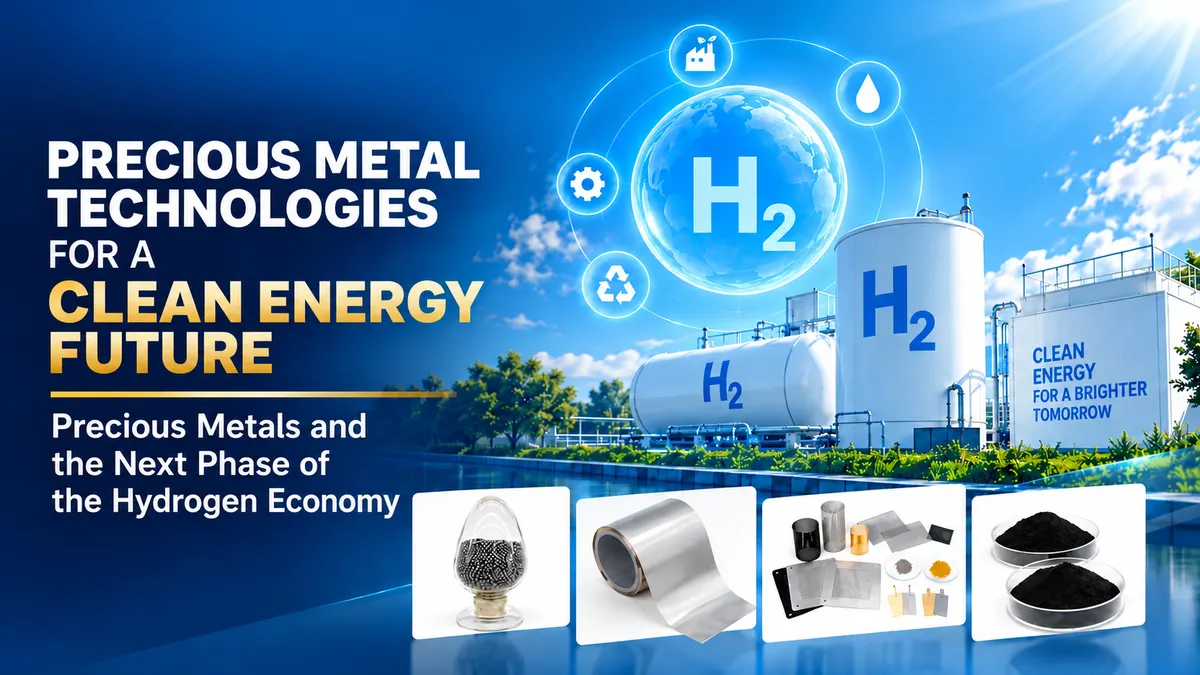

As hydrogen technologies move toward industrial deployment, the materials inside these systems must deliver more over a longer operating life while making increasingly efficient use of scarce resources. This creates an important challenge for the hydrogen economy: reducing precious-metal use is important, but using less material does not necessarily mean using it more efficiently. The more relevant question is how much performance, and operating life can be obtained from the precious metals required by the system—and how those metals can ultimately be recovered and returned to productive use.
Hydrogen has long held promise as a tool for decarbonizing sectors where direct electrification can be difficult. The challenge now is to move from demonstration and early commercial applications toward reliable, economically viable deployment at industrial scale.
The market is growing, but commercialization remains limited. Global hydrogen demand surpassed 100 million metric tons in 2025, according to the International Energy Agency (IEA), while low-emissions hydrogen production remained at about one million metric tons. Installed electrolysis capacity nevertheless doubled during the year to more than four gigawatts, illustrating both the momentum and the scale of the transition still required.
Yet scaling hydrogen is not simply a question of installing more electrolyzers or fuel cells. It also raises a materials challenge. Many hydrogen technologies depend on precious metals that are finite, costly and, in some cases, geographically concentrated.
Hydrogen production, purification and utilization place very different demands on catalysts and components. For materials providers, this means considering not only catalyst performance, but also how effectively precious metals are used over their operating life and what happens to those metals after service.
The objective, therefore, is not simply to minimize precious-metal content. It is to obtain greater value from these materials throughout their lifecycle.
Why precious metals are still essential
Precious metals remain important to several hydrogen technologies because alternative materials can struggle to match their performance under demanding operating conditions. Their catalytic and functional properties are particularly valuable where high activity must be sustained in chemically aggressive environments.
Platinum (Pt) supports electrochemical reactions in fuel cells and water electrolysis. Iridium (Ir) is important to polymer electrolyte membrane (PEM) water electrolysis, particularly under the highly oxidative conditions at the anode. Palladium (Pd) selectively permeates hydrogen, enabling separation from other gases, while ruthenium (Ru) and rhodium (Rh) can support hydrogen-production and gas-processing reactions.
As hydrogen deployment expands, the cost and scarcity of precious metals make more efficient use essential. For instance, the U.S. Department of Energy notes that iridium accounts for much of the platinum group metals (PGMs) content in PEM electrolyzers. DOE has established targets that call for substantial reductions in total PGM loading while maintaining performance and durability. The IEA has also identified reducing critical-material intensity as an important area of electrolyzer innovation.
For several critical hydrogen technologies, precious metals are therefore likely to remain important even as the industry works to reduce material intensity. TANAKA approaches this challenge across the precious-metal lifecycle, connecting materials development and manufacturing with recovery and refining. This allows catalyst performance to be considered alongside efficient resource use and the potential to return valuable metals to production.
Addressing challenges from production to utilization
What efficient precious-metal use means in practice differs across the hydrogen value chain:
Production
PEM water electrolysis relies on catalysts that support two demanding electrochemical reactions. Pt-based cathode catalysts support the hydrogen evolution reaction (HER), while Ir-based anode catalysts support the oxygen evolution reaction (OER).
At the anode, highly oxidative electrochemical conditions place demanding requirements on catalyst materials. Ir provides the catalytic performance and corrosion resistance needed under these conditions, but it is also one of the rarest PGMs. Improving Ir utilization is therefore an important engineering priority.
Advanced catalyst design can increase the amount of Ir that contributes effectively to the reaction. Higher surface area and improved mass activity, for example, can help reduce Ir loading while maintaining the activity and durability required by the system. TANAKA is developing high-surface-area water-electrolysis catalysts with this objective.
“The objective is not simply to use less precious metal. It is to use the material more effectively while maintaining the performance and durability required by the system. Lower loading only creates value if the catalyst continues to deliver the activity and durability required by the system,” says Dr. Torsten W. Buennagel, Fuel Cell Manager, TANAKA PRECIOUS METAL TECHNOLOGIES Co., Ltd.
Hydrogen will continue to be produced through multiple pathways during the transition, creating different catalyst requirements. Ru- and Rh-based catalysts can support hydrogen production from hydrocarbons, while shift-reaction and preferential oxidation (PROX) catalysts can increase hydrogen yield and reduce residual carbon monoxide (CO) in hydrogen streams.

Caption: Catalyst design for PEM water electrolysis must balance activity and durability with efficient use of finite and limited materials such as Ir |TANAKA.
Purification
Hydrogen produced from various processes can contain other gases and contaminants that must be removed before certain downstream uses.
Palladium selectively allows hydrogen to pass through a membrane while blocking other gases. That makes palladium-alloy membranes useful for producing high-purity hydrogen. Continued materials development is also expanding the operating conditions available for these systems.
For example, TANAKA has developed palladium-alloy membrane technology designed to achieve high hydrogen permeability at low operating temperatures.

Caption: Pd-alloy membranes use the selective permeability of Pd to separate hydrogen from other gases | TANAKA.
Utilization
Polymer electrolyte fuel cells (PEFCs), also commonly referred to as proton exchange membrane fuel cells (PEMFCs), depend on electrocatalysts that combine high activity with long-term durability.
Because PEFCs operate at relatively low temperatures, highly active catalysts are required to achieve practical reaction rates. Pt and Pt-based alloy catalysts remain important because matching their combination of catalytic performance and durability with alternative materials remains challenging.
Here again, reducing metal content is only part of the engineering challenge. Particle size, dispersion, surface area, catalyst-support interactions, and electrode design can all affect how effectively Pt contributes to the reaction.

Caption: Polymer electrolyte fuel cells use Pt-based electrocatalysts to convert hydrogen and oxygen electrochemically into electricity and water | TANAKA.
TANAKA has developed PEFC electrocatalysts since 1985. Its work includes the uniform dispersion of Pt-alloy on carbon, illustrating how catalyst design can improve material utilization without simply increasing precious-metal loading.

Caption: PEFC electrocatalysts use precious metal catalyst, mainly made of Pt-alloy | TANAKA.
From performance to material productivity
As hydrogen technologies move toward industrial scale, metal loading alone provides an incomplete picture of resource efficiency. A more useful concept is “material productivity”: how much useful performance and operating life can be obtained from the precious metal required to deliver a particular function.
Material productivity depends on more than metal loading. Manufacturability, operating efficiency, and expected service life also determine how much value is obtained from a catalyst. A lower loading provides limited benefit if it leads to faster degradation , reduced system efficiency or more frequent component replacement.
Using a precious metal efficiently therefore does not necessarily mean minimizing its quantity. The relevant measure is whether the required performance can be sustained over the intended operating life. Catalyst architecture and dispersion influence how effectively the metal is used, while stability and manufacturing consistency determine how well that performance is retained.
Circularity begins before end of life
Material productivity also does not end when a catalyst or component reaches the end of its first service life. Responsible precious-metal management extends beyond the amount used in a single component. Circularity can begin during development, through appropriate loading and targeted application, and continue through manufacturing by limiting variability and waste. Longer component life delays replacement: once material reaches end of life, recovery and refining can return valuable metals to manufacturing.
Supply trends also highlight the importance of material availability. According to the U.S. Geological Survey, production of platinum group metals in South Africa fell by an estimated 9% in 2025, with the agency citing factors including mining costs and electricity supply disruptions. Against that backdrop, circularity is becoming relevant to resource security as well as environmental objectives. A 2025 European Commission Joint Research Centre study identified greater iridium-specific recovery and product designs that support dismantling as potential strategies for strengthening the hydrogen technology value chain. The U.S. Department of Energy has likewise committed $50 million to a consortium focused on recovering and reusing materials from electrolyzers and fuel cells. These developments illustrate why circularity matters not only for waste reduction, but also for long-term material availability and supply resilience.
“We need to think about precious metals across the full lifecycle. Improving how efficiently they are used is one part of the challenge; extending their productive life and recovering them for reuse are equally important,” Dr. Buennagel said. TANAKA's industrial precious-metals operations connect procurement, and materials development, with manufacturing, recovery and refining. Recovered and refined precious metals can be returned to manufacturing, linking materials development with resource circulation across the product lifecycle.
Building hydrogen systems for scale
Scaling hydrogen will require lower costs, stronger supply chains and more productive use of limited and precious resources throughout their lifecycle.
The next phase of the hydrogen economy will depend not only on producing more hydrogen systems, but on obtaining more performance and longer life from the materials inside them. For precious metals, that means connecting catalyst development and manufacturing with recovery and refining to make more effective use of precious metals across the full lifecycle.
Hydrogen Technology World Expo 2026
TANAKA to showcase precious metal technologies supporting hydrogen production, purification, utilization, and precious-metal circularity at Hydrogen Technology World Expo 2026, October 20–22 at Hamburg Messe in Hamburg, Germany, Hall B7, Booth 7J54.
Explore TANAKA’s precious-metal technologies for hydrogen production, purification, utilization and circularity, visit: The Role of Precious Metals in Contributing to Carbon Neutrality.
For product inquiries, contact TANAKA’s industrial precious metals team: Inquiries on Industrial Products.
| Dr. Torsten W. BUENNAGEL
Fuel Cell Manager TANAKA PRECIOUS METAL TECHNOLOGIES Co., Ltd. Dr. Torsten W. Buennagel is Fuel Cell Manager at TANAKA, with responsibilities spanning TANAKA PRECIOUS METAL TECHNOLOGIES Co., Ltd. and Metalor Technologies SA, a group company of TANAKA. With more than 15 years of experience in precious-metal catalysts, he leads business development for fuel-cell and water-electrolysis catalysts, working with customers and industry partners to support the commercialization of hydrogen technologies and the development of circular precious-metal value chains. He holds a doctorate in macromolecular chemistry from the University of Wuppertal. |
 |