Fast fashion brands have increasingly been advertising “sustainable fashion” campaigns and initiatives that claim to lower their carbon footprint, chemical pollution and resource use. However, a closer look at their annual reports and external data tells another story.
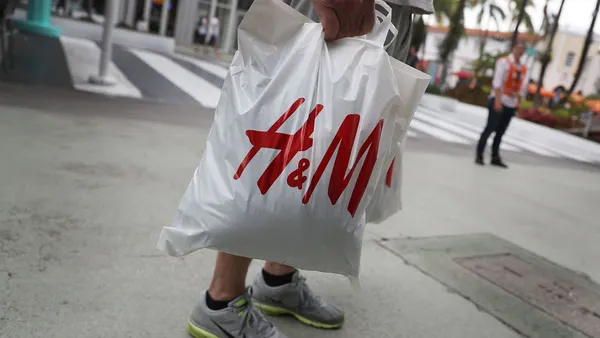
Behind the green marketing lies an overwhelming volume of production and a lack of transparency regarding the waste that goes along with it. For instance, retail giant H&M’s latest sustainability report notes that 91% of the materials used to make its products were sustainably sourced. But the report also notes that the company created 364,093 metric tons of products in 2025, the equivalent of 36 Eiffel Towers.
“Our starting point is always our business idea: fashion and quality at the best price in a sustainable way,” Daniel Ervér, CEO of H&M, said in the report.
Competitor Inditex, which owns eight brands, including Zara and Bershka, used 705,554 metric tons of raw materials in its products, up from 678,596 metric tons in 2024, according to its 2025 sustainability report. In the report, Inditex CEO Óscar García Maceiras states that 88% of the fibers used to make those products qualified as “lower impact fibers,” echoing similar claims made by rival H&M.
Shein, which lists as many as 600,000 items for sale at a time on its online shopping platform, has a sustainability page announcing its “commitment to being more responsible for our environmental impact and improving lives in the communities we reach.” This year, it acquired sustainable clothing brand Everlane, which claims, “We’re on a mission to clean up the industry. It’s a movement we’re calling cleaner fashion.”
These days, the most visible sustainability messaging in the fashion industry comes from fast fashion companies whose business models have proved to be a winning recipe. In terms of revenue, H&M, Zara and Shein reported about $23.5 billion, $46.3 billion and over $50 billion in sales in 2025, respectively.
In 2016, H&M announced that it wanted to become a circular company by 2040, as part of its partnership with the nonprofit Ellen MacArthur Foundation. Part of that circularity plan involves, “creating products that are made to last from safe, recycled, and more sustainably sourced materials (that are either naturally grown, cultivated or created using renewable processes) that can recirculate multiple times.”
However, the fast fashion business model leads to tens of thousands of metric tons of reported waste for these companies and potentially hundreds of thousands metric tons more in underreported upstream waste. And sustainability and circularity goals may not be enough to grapple with the pace of production.
‘Difficult, if not altogether impossible’
While it can be hard to verify sustainability claims for companies that operate on such large scales, these claims deserve special scrutiny because of the underlying business model, according to Javad Nasiry, professor of operations management at McGill University, whose research focuses on sustainability and fast fashion.
“The fast fashion business model, by design, is difficult, if not altogether impossible, to be made sustainable,” Nasiry said.
Inditex’s sustainability page says that their goal is to create “garments that stay in our customers’ wardrobes over time.” But the business model that has made Inditex, H&M and Shein so successful involves bringing a wide variety of products to match customer trends at high speeds and a low price. And in that process, “something has to give, and that usually is the quality,” according to the professor.
Low product quality undermines the circularity that H&M and Inditex say they’re aiming for. And the trend-driven nature of fast fashion pushes consumers to buy new clothes even when the ones they have are still usable: “by the time you get to the third [wear], it’s already a new collection,” he added.
In addition, Nasiry said that sustainability claims often focus on the impact of individual products. “There is a difference between the environmental impact of, let's say, one unit of product, and the environmental impact of the entire business,” he said. A T-shirt may be sustainably sourced and thus lower-impact, but if the number of t-shirts produced is extremely large, the total environmental impact can still be substantial, he said.
Nonprofit Textile Exchange sets the standards for the “preferred materials” cited in H&M and Inditex’s reports. The organization defines these as materials produced in a way that “deliver reduced impacts and increased benefits for climate, nature, people, and animals against the conventional equivalent.” The nonprofit’s overarching goal is to guide brands toward production systems that reduce raw material greenhouse gas emissions by 45% by 2030. H&M, Inditex, Shein and Everlane are all members of Textile Exchange’s network.
A spokesperson from Textile Exchange told ESG Dive in emailed comments that “simply substituting conventional, extractively-produced materials for those from preferred production systems” will not be enough to reach its 2030 target if the “rapid growth in production of new fibers and materials — particularly those from new virgin fossil-based sources — is not addressed.”
Between 2019 to 2025, global fiber and raw material production associated with the apparel, home textiles and footwear industry rose from about 71 million metric tons to 93 million metric tons, with greenhouse gas emissions also rising about 30%, despite the share of preferred materials rising, the spokesperson from Textile Exchange said.
Even using recycled materials can have an unexpected negative impact on circularity, says Xiaoyang Long, associate professor of operations and information management at the University of Wisconsin-Madison. While recycling lowers the overall emissions of a product, recycled materials, whether cotton or polyester, can be less durable, Long said, which shortens the product’s useful life.
“I don’t see how they can circulate it forever,” she added.
The ‘quick response’ trap
Another claim that fast-fashion retailers make is that they are able to react quickly to trends, which leaves them with little inventory on shelves and appears to solve the problem of unsold stock going to waste.
Inditex, for example, is known for keeping much of its production close by in Spain, Portugal, Morocco and Turkey in order to bring products to market faster. “Our retail concepts excel in their capacity to adapt and respond to any change in the market or the irruption of a new trend, thanks to fine-tuned production processes, with short runs that are fully adapted to demand,” the brand writes in their 2025 sustainability report. “This also allows us to maintain a tight inventory.”
Meanwhile, Reformation, which became a publicly traded company this year, has touted its ability to bring products into stores in 60 days or less. This is a rapid turnaround time for a brand that is famous for the tagline “Being naked is the #1 most sustainable option. We’re #2.”
But this type of “quick response,” as it’s known in operations management, is not a silver bullet for avoiding waste, Long said. Instead, it can move waste further up the production stream, according to her analysis. “Not every stage of the supply chain can be made faster,” she said. “You can’t grow cotton on demand.”
That means that companies must have a lot of variety of fabric, materials, patterns and the like, available further up in their supply chains, which is where most of a products’ environmental impact lies.
“The faster you are in the front, the more you need at the back,” Long said, noting that a lot of that actual preparation would end up going to waste as the brand focuses on the trends that sell.
It’s hard to quantify this waste as it’s outside the scope of the brands’ sustainability reports. In 2025 H&M reported 54,766 metric tons of waste in its own operations. Meanwhile, Inditex reported 58,154 metric tons of waste in its operations. There is no clear data in either report on the waste further upstream in the supply chain, but according to H&M’s latest sustainability report, taking into account production waste, it used 506,015 metric tons of materials in its products. That’s a difference of at least 141,922 metric tons between the weight of materials and the weight of its final products, because lining and filler weight are not accounted for in total material weight, although H&M does not explicitly say that this difference is indeed waste.
Quick response also works against circularity because it drives consumer behavior, Long said. The “almost instant gratification is going to inevitably push consumers … to want to buy more, like whatever the whim of the week is,” she said. Combined with social media, that creates a feedback loop where trends — and collections — renew themselves on shorter and shorter time scales. “So if whatever they want, they can get right away, then that is going to lead to more consumption, most likely overconsumption,” she said–the opposite of garments staying longer in customers’ closets.
H&M declined to comment for this story on whether it intended to meet its circularity goals while maintaining or increasing production volumes. Inditex and Everlane did not respond to requests for comment as of press time.
Resale, regulation, and the race to fix the problem
So far, consumers in the United States have tried (and failed) to sue H&M for greenwashing by questioning whether the materials used are truly sustainable, not by pointing out the issues overproduction poses. But legislation is now coming online that appears to be targeting overproduction itself.
This July, the European Union’s ban on destroying unsold clothing came into effect. And on Sept. 1, a French law came into effect — designed to target Shein and Temu rather than H&M and Inditex — that taxes items bought from platforms based on the number of total items those companies sell. Extended producer responsibility laws such as California’s Senate Bill 54 targeting packaging waste, which charge producers for disposing of items, are often suggested as a measure to reduce production.
Such laws, which amount to taxing production, might seem to get at the root of the problem. But Nasiry said such laws have to be designed carefully, otherwise companies will be motivated to pass costs onto customers or “react by decreasing the quality even more, which is not the effect that the government may have in mind.”
Resale has also been proposed as a path to circularity, allowing consumers to buy without using any additional resources. In 2019, H&M became the majority owner of second-hand online retailer Sellpy, which operates in 24 European countries. But only 0.8% of H&M’s total revenue came from resale in 2025, up from 0.6% in 2024. This year, H&M, Inditex, Reformation and dozens of other textile brands and organizations called for reduced value added tax in Europe and no sales tax in the U.S. for resold products under an initiative spearheaded by the Ellen MacArthur Foundation.
Nevertheless, Long sees some promise in resale. If companies try to boost resale markets for their products, that might get consumers to value quality because they’ll be thinking of how to resell the product down the line, she said. That, in turn, could “induce companies to switch to a business model that provides that higher value,” she said.
In the meantime, despite increased public awareness of the fashion industry’s environmental impacts, consumers’ hunger for fast fashion doesn’t seem to be going away. As of now, the hashtag #sheinhaul on TikTok has 1.6 million videos.
“It's a very, very difficult problem to fix,” Long said.