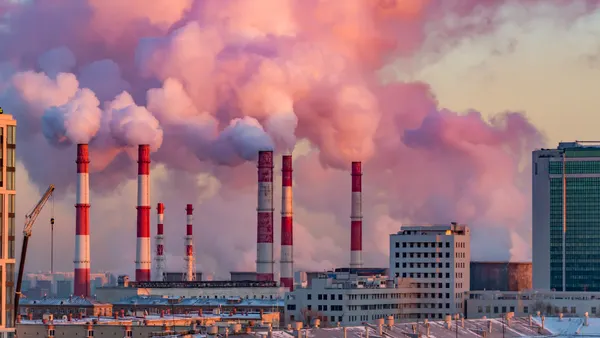

The U.S. Environmental Protection Agency on Friday extended the deadline for major industrial sources of greenhouse gas emissions to report their 2025 totals to the Greenhouse Gas Reporting Program. The move pushes back the March 31 deadline to Oct. 30, by which time the agency may have finalized a rule removing the obligation to report such emissions at all for most categories of facilities.
"The extension will not impact the agency’s ability to fulfill its core mission given that the GHGRP has no material impact on improving human health and the environment," noted the agency in an unattributed statement emailed Tuesday.
The Greenhouse Gas Reporting Program was created in response to a congressional mandate in 2008 and began collecting data in 2010. Over time, it has grown to include 47 categories of facilities, including power plants, refineries, chemicals manufacturing, electronics manufacturing, pulp and paper manufacturing and waste disposal.
In September, the agency proposed revisions to the program that would permanently remove reporting obligations for all but one source category, petroleum and natural gas systems, which the EPA still must collect due to a provision of the Inflation Reduction Act of 2022. It proposed pushing back the start of reporting requirements for that remaining category to 2034.
The agency said the data collection effort was unnecessary and burdensome to reporting entities. Ending reporting requirements would save American businesses at least $303 million annually, according to the proposal.
The Greenhouse Gas Reporting Program's data has previously been used to inform the long-running annual U.S. Inventory of Greenhouse Gas Emissions and Sinks, which President Donald Trump also halted last year. It comes amid his broader campaign to roll back climate-related regulations across the federal government, dismantling what EPA Administrator Lee Zeldin has called "the Green New Scam."
Those efforts include rolling back the "endangerment finding" a key scientific determination the agency reached in 2009 that underpins many of its regulations addressing climate change. The process by which the agency reversed the finding was controversial, and it has now been challenged in courts by states and environmental groups. Some have argued the agency's other actions, like attempting to halt Vermont and New York's climate Superfund laws, undermine EPA's core claim that it has no obligation under the Clean Air Act to address greenhouse gas emissions.
Some industry groups have noted concerns with ending the Greenhouse Gas Reporting Program. A coalition led by the U.S. Chamber of Commerce argued against a full rescission of the program and instead advocated for targeted changes to some of the reporting requirements. The program, according to the coalition, “serves important market, regulatory, and competitiveness functions for American business.” Without it, industry could be subject to a patchwork of state regulations.
Environmental groups have also pushed back strongly against the agency's attempt to dismantle the program. David Doniger, a senior attorney with the Natural Resources Defense Council, noted that much of the savings EPA projects would come from rolling back reporting requirements apply to the oil and gas sector — and less than $50 million annually would be saved by the remaining categories of obligated parties.
Many commenters also noted the collected data has informed several EPA functions that could suffer under a rescission. That includes setting emissions standards for power plants, landfills and oil and gas operations, as well as setting up tax credits like the Section 45V Clean Hydrogen Tax Credits and Section 45Y Clean Electricity Tax Credits.
Doniger further argued that Congress clearly intended the program to continue when it initially mandated its creation, and that the EPA provided insufficient cause for the program's undoing.
"That current EPA leadership does not intend to regulate GHGs is not a reasonable basis for repeal. EPA’s authority to stop regulating dangerous climate pollution is, to say the least, unresolved," Doniger said. "EPA’s obvious goal is to put obstacles in the path of a future administration, forcing it to start from scratch. That is not a rational basis for repeal."
The EPA did not provide a timeline for a final decision, but said it would occur "within a timeframe that allows affected sources to incorporate the proposed changes, if finalized, into their reporting."