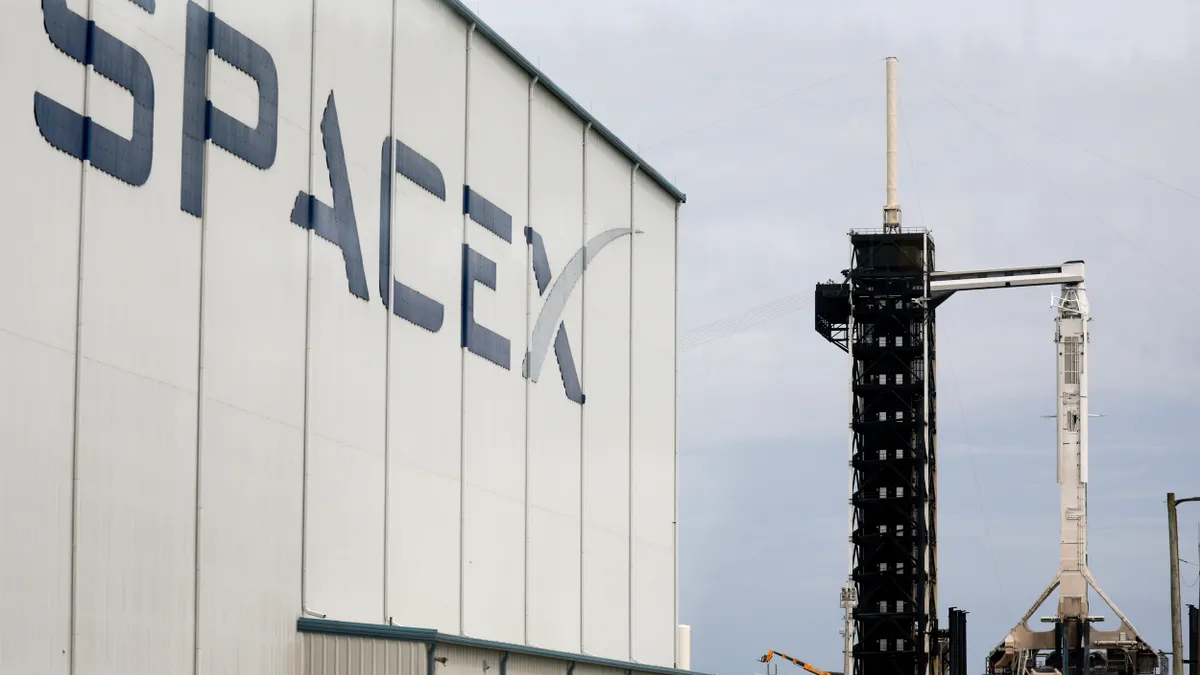
SpaceX, the Elon Musk-owned space transportation services and aerospace manufacturing company, is planning to make its initial public offering this Friday. The IPO will present a new investment opportunity for retail buyers and, shortly after, institutional investors.
The total company — comprising, in part, satellite internet company Starlink and the social media and artificial intelligence company xAI, as well as a space exploration venture — is valued at $1.75 billion by PitchBook, a private market research arm of Morningstar. However, SpaceX is opting for a dual-class public offering expected to raise around $75 billion, according to Morningstar.
“There's concerns over the dual class share scheme, for certain, but also concerns over the composition of the board,” Morningstar Director of Institutional Insights Lindsey Stewart told ESG Dive Monday.
Stewart said that corporate governance has taken on a “very unconventional approach … for a number of years,” not just at SpaceX, but at Musk’s other companies as well.
“Investors have concerns over whether that means they might be disadvantaged in some way in the near future when it comes to the way that the company is controlled and directed,” he added.
SpaceX will be domiciled in Texas — like fellow Musk-owned company Tesla — and listed on the Nasdaq starting Friday at $135 per share. The stock is expected to be included in some index funds before the end of the month.
Index providers like FTSE Russell and Nasdaq made rule changes this year to speed large capitalization companies into index offerings in five and 15 days, respectively, in anticipation of the IPOs of SpaceX, AI companies Anthropic and OpenAI, and others. Index providers like financial services firms Morningstar and MSCI have existing policies in place to speed large cap companies to indexes. S&P broke ranks last week, announcing it wouldn’t amend its rules.
ESG Dive interviewed Stewart to discuss the upcoming IPO, institutional investors’ concerns and how fast-track rule changes play in.
Editor’s note: This interview has been edited for length and clarity.
ESG DIVE: When it comes to the SpaceX IPO, what did the filing propose and what has some investors concerned?
LINDSEY STEWART: There are concerns among a number of institutional investors that domiciling in Texas allows companies like SpaceX and Tesla to implement provisions that disadvantage them and advantage corporate management — and that's around the ability to file shareholder resolutions and have them voted around, the ability to litigate if shareholders aren't happy with particular corporate practices. SpaceX is also opting for a mandatory arbitration clause in their corporate charter, which institutional investors tend to oppose. They want the option to take court action if they feel it is needed. They feel that's an important governance balance.
There are a few related party transactions [disclosed in the SEC filing] that have raised a few eyebrows. Some with a company called Valor [Equity Partners], which is run by one of the SpaceX directors [Antonio Gracias], who has been a serial director at several of Musk's companies. Alongside that, there's been a perception that some of the directors who have also served on the board of Tesla have frequently been a little too close to Elon to challenge him on behalf of independent shareholders, so there are worries that will recur at SpaceX.
All of those are side issues compared with the dual class share scheme. I think just under half of the total outstanding shares in SpaceX are Class B shares that are only allowed to be held by Elon Musk and a few of his directors. They will have 10 votes per share instead of the usual one owned by Class A shareholders, which is between the rest of the company. That will effectively allow Musk and his close followers, who own Class B shares, to control the company with a thin sliver of the equity. Now, at the moment, Musk and his other directors who hold Class B shares, have a very substantial stake in the business, but it allows them 85% voting control over the company, which is not matched with their economic stake.
It's similar to the issue that we see at Alphabet or at Meta platforms, where the founders of those businesses are able to control more than half of the votes with a relatively small economic stake. Institutional investors don't like them because they reduce the level of accountability to shareholders and they provide incentives that are misaligned with the economic stake that each shareholder has.
How unique is the structure of the dual-class IPO? Could you elaborate on why some institutional investors are concerned?
Most companies have a single class of stock with one vote per share. There are some exceptions that have become more prevalent, and they tend to be concentrated in the tech sector in the United States where founders have sought to have a larger level of control over their business, so they can execute whatever their long-term strategy is.
Now, it is entirely possible for companies with dual-class share schemes to thrive in the market and for their share price performance to go well. But the concern on the part of institutional investors is that it is unlikely that all of these companies have directors that can maintain a persistent strategic advantage by being led and controlled by their founders over the very long term.
At the very least, if there is a dual class share scheme, [investors are] very alert to the idea that there should be a sunset clause. The recommended term is a maximum of seven years, after which, extension is at least put to shareholders for a vote or the dual-class share scheme would end. What investors don't want to see is this preferential treatment for directors or founders in the business to extend over a lifetime or perhaps more, because it is entirely possible that these founders are not omniscient or all powerful or could know what the future is.
Where does the xAI of it all tie in?
It's an interesting question because I think xAI has kind of gotten lost in the giant business that is now SpaceX. Both those companies were merged a while ago [in] a no cash transaction.
So, the amount of corporate value that is being attributed to xAI shareholders, and within that, formerly Twitter shareholders, compared with original SpaceX shareholders, and all the private institutions that will have invested in that business, is all pretty opaque at the moment.
Adding all this up, what are you watching with this IPO and how are fellow institutional investors wading through this IPO?
One of the key points of concern for institution investors is eligibility for index inclusion. A number of index providers, Morningstar included, have decided to fast-track the issue, reflecting the fact that the sheer size of these IPOs probably does warrant some kind of alternative treatment compared to with much smaller issuances — given that the index is supposed to reflect everything that's available for sale for an investor to buy.
The question it raises, though, is with this company and others being included with such speed, what is the effect of that on the share price over the intermediate term?
There is a little bit of concern, particularly on the part of institutional shareholders who are beginning to view SpaceX as a company that, due to its size and index inclusion, they don't really have a choice about holding. Meanwhile, they have significant concerns about the way the company is directed and controlled, and so they're just watching to see how that plays out.