Dive Brief:
- The Glasgow Financial Alliance for Net Zero — a private sector initiative to mobilize finance for the transition from fossil fuel — launched a public repository to make it easier to find capital and risk mitigation instruments for to fund clean energy and climate resilience and adaptation projects in emerging and developing markets.
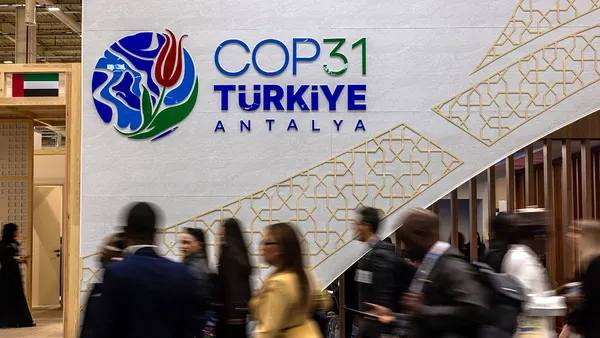
- GFANZ announced the new tool at COP31 in Antalya, Turkey, on Wednesday, and the repository is designed to make it easier to access and compare market instruments and find financing in emerging markets and developing economies, according to a press release.
- The “Catalytic Capital Repository” is hosted by Global Capacity Building Coalition, which was launched at COP28 in the United Arab Emirates in 2023. GFANZ also announced Thursday that it was partnering with Turkey’s Ministry of Industry and Technology to accelerate industrial decarbonization in the country.
Dive Insight:
GFANZ was launched in 2021 at COP26 in Glasgow, Scotland, by Canada’s Prime Minister Mark Carney, who was then the UN’s special envoy on climate action and finance. GFANZ oversaw climate finance alliances like the Net-Zero Baking Alliance before pivoting to a focus on capital mobilization in 2025 amidst NZBA defections and increased scrutiny.
Under the pivot, the organization — currently chaired by Michael Bloomberg, who founded the GCBC in 2023 — engages stakeholders through a principals group that includes Citigroup CEO Jane Fraser and BofA CEO Brian Moynihan, as well as BlackRock Vice Chair Phillipp Hildebrand and State Street CEO and Chair Ronald O’Hanley, among others.
The repository is designed to help financial institutions looking to increase funding for clean energy investment, resiliency and adaptation projects in emerging markets and developing economies by identifying other institutions that could support a particular transaction or fund designed to accelerate, according to the Wednesday press release.
GFANZ Vice Chair Mary Schapiro said in the release that the repository should make “catalytic capital easier to find, compare, and access,” which would allow other institutions to focus on “structuring investable transactions.”
“Mobilizing private finance in emerging markets requires practical market infrastructure that helps reduce the transaction and search costs associated with blended finance or accessing guarantees,” Schapiro, a former chair of the Securities and Exchange Commission and Commodity Futures Trading Commission, said in the release. Schapiro also chairs the GCBC.
GFANZ said it developed the repository with input from multilateral development banks, development finance institutions, banks, fund managers and other types of private sector inventors. The repository should allow users to compare financial providers, financing programs, available market instruments and the eligibility criteria and application pathways for financing, according to the release.
The first cohort of repository members includes over 30 institutions across North America, Europe, Africa and Asia. Among the initial members are development banks and financial institutions, as well as philanthropic investors like Allied Climate Partners, sustainable investor Climate Investment Funds and multilateral climate fund the Green Climate Fund.
“Private capital is essential to financing infrastructure, driving sustainable growth, and creating jobs in EMDEs, yet mobilizing it at scale remains a persistent challenge,” GFANZ said.
As part of its decarbonization partnership with Turkey’s Ministry of Industry and Technology, GFANZ will look to increase and strengthen collaboration between the country’s government and private and development financial institutions, according to a Wednesday press release.