Dive Brief:
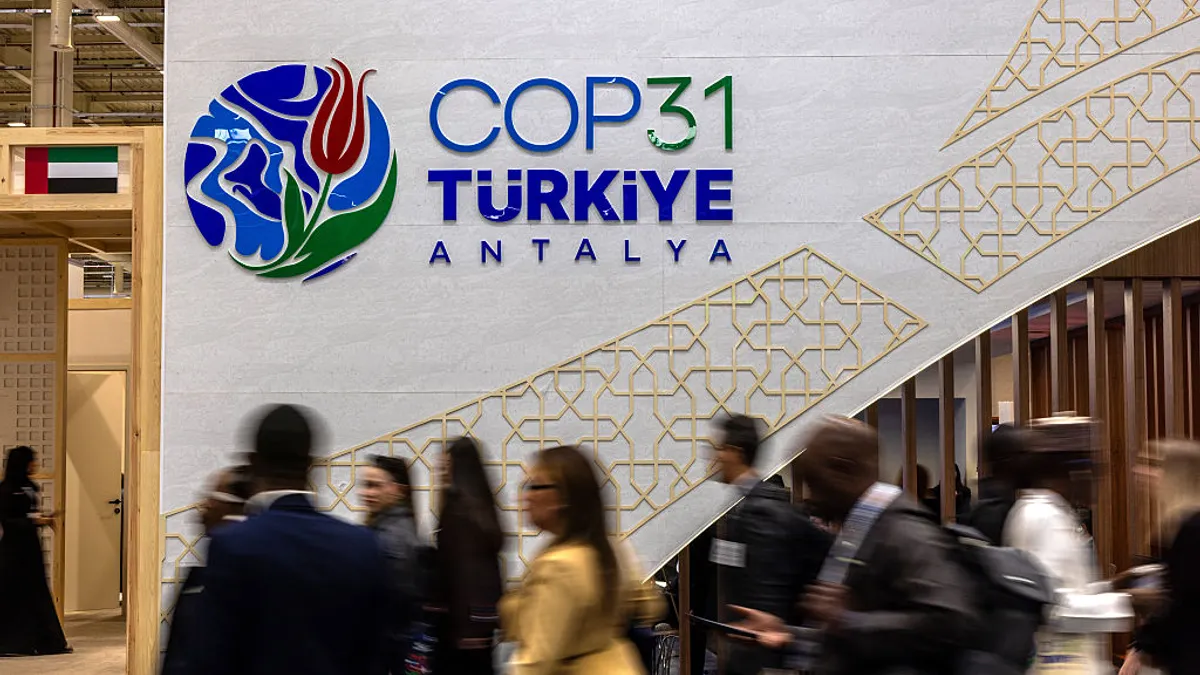
- Over 180 companies have called on the COP31 presidency to close the gap between clean energy ambition and actual action being taken to transition from fossil fuels, in a statement organized by climate nonprofit the We Mean Business Coalition.
- The Nov. 3 statement is backed by a broad range of signatories, including H&M Group, Ikea, Danone, Uber, Schneider Electric and Volvo Cars and was published just a few days before the annual climate summit kicked off in Antalya, Turkey.
- The companies, who collectively represent annual revenues of $1.69 trillion, asked global governments to fast-track electrification and “make clean electrification a central pillar of economic and industrial strategy,” according to the statement released last week.
Dive Insight:
The COP31 presidency is organized under a unique joint arrangement between Turkey and Australia. The two countries are co-hosting the annual climate summit this year, marking a break from tradition in the summit’s over three-decade history.
This year, Turkey will oversee the venue and logistics while Australia will lead the official negotiations. The presidency for the summit is shared between Turkey Minister of Environment, Urbanization and Climate Change Murat Kurum and Australia Minister for Climate Change and Energy Chris Bowen.
Electrification is a core part of the COP31 action agenda. The presidency is advocating for a “35x35” target that entails increasing electricity’s share of the world’s final energy consumption from around 20% today to 35% by 2035.
The summit has scheduled a number of panels and talks on how electrification can be accelerated to achieve this goal and how governments, agencies and industry can work together to make reaching such a target possible, especially in emerging and developing economies.
We Mean Business Coalition said its global polling of business leaders found a gap between company ambition and government delivery when it came to electrification. Sixty-nine percent of respondents to that survey said their companies were adopting electrification faster than the pace governments were preparing for.
The global nonprofit also pointed to its Electrification Competitiveness Index, which found that major economies were failing to convert their climate policies into actionable progress, despite having the necessary regulation and infrastructure in place to support such a clean energy transition. According to the index, China is leading when it comes to electrification, while the United States faces significant risk of losing its momentum. It also found that European nations like the United Kingdom, Germany, Italy and Poland are struggling to translate their robust policies into tangible results.
“Without faster progress, countries are left more exposed to energy insecurity and volatile prices, while industrial competitiveness and investment suffer,” the Nov. 3 statement said. “Businesses face higher costs, delayed projects and tougher decisions about where to put capital.”