Dive Brief:
- Geothermal energy developer Fervo Energy debuted on the Nasdaq Exchange Wednesday with an initial public offering valued at $1.89 billion, with its co-founders ringing the exchange’s opening bell. Fervo offered 70 million shares at a $27 per share IPO price, according to a release issued Tuesday.
- This represents an upsized IPO for the next-generation geothermal company, which previously announced that it expected to issue about 55.6 million shares at $21 to $24 per share.
- The initial stock offering comes as energy buyers are increasingly looking to purchase baseload carbon-emissions free energy like geothermal and nuclear power generation, Corporate Energy Buyers Association CEO Rich Powell recently told ESG Dive.
Dive Insight:
Fervo, founded in 2017, uses proprietary technology to drill horizontally into geothermal reservoirs to allow it to access multiple wells from a single spot. The technique allows the company to lower the surface footprint of the wells and reduce drilling risks, according to its website.
The company made its securities filing to register the ticker and stock offering to the Securities and Exchange Commission in April, and it was declared effective as of March 12, according to Tuesday’s release.
Fervo CEO Tim Latimer said at Wednesday’s opening bell that he and fellow co-founder Jack Norbeck, who also serves as the company’s chief technology officer, created the company to answer the question of whether advances in drilling techniques from the oil and gas industry could "similarly revolutionize the geothermal industry.” Latimer said Fervo’s IPO shows that they “proved that the answer to that question is yes.”
“We have proven that geothermal deserves a spot among the major energy players, and Fervo is leading that charge,” Latimer said. “It is crystal clear now that energy is the cornerstone upon which [artificial intelligence], competitiveness, national security, economic development and affordability will all be hinged upon, and it's our belief that geothermal energy will play a central role in that activity.”
JPMorgan, Bank of America Securities, RBC Capital Markets and Barclays were jointly the lead bookrunning managers for the IPO, while eight other financial institutions, including Societe Generale and BBVA, also assisted, according to Tuesday’s press release. Underwriters of the deal were granted a 30-day option to purchase up to an additional 10.5 million shares.
Nasdaq Senior Vice President of Listings Rachel Racz said that Fervo is “helping redefine what the future energy mix can look like,” prior to Wednesday’s opening bell.
“Fervo is joining the market at a pivotal moment for the energy sector,” Racz said. “Demand for clean, reliable, always-on power has never been greater, and Fervo is addressing that challenge head on by scaling enhanced geothermal systems in a way the industry has not seen before.”
The company’s ticker symbol is FRVO and the offering is expected to close on Thursday.
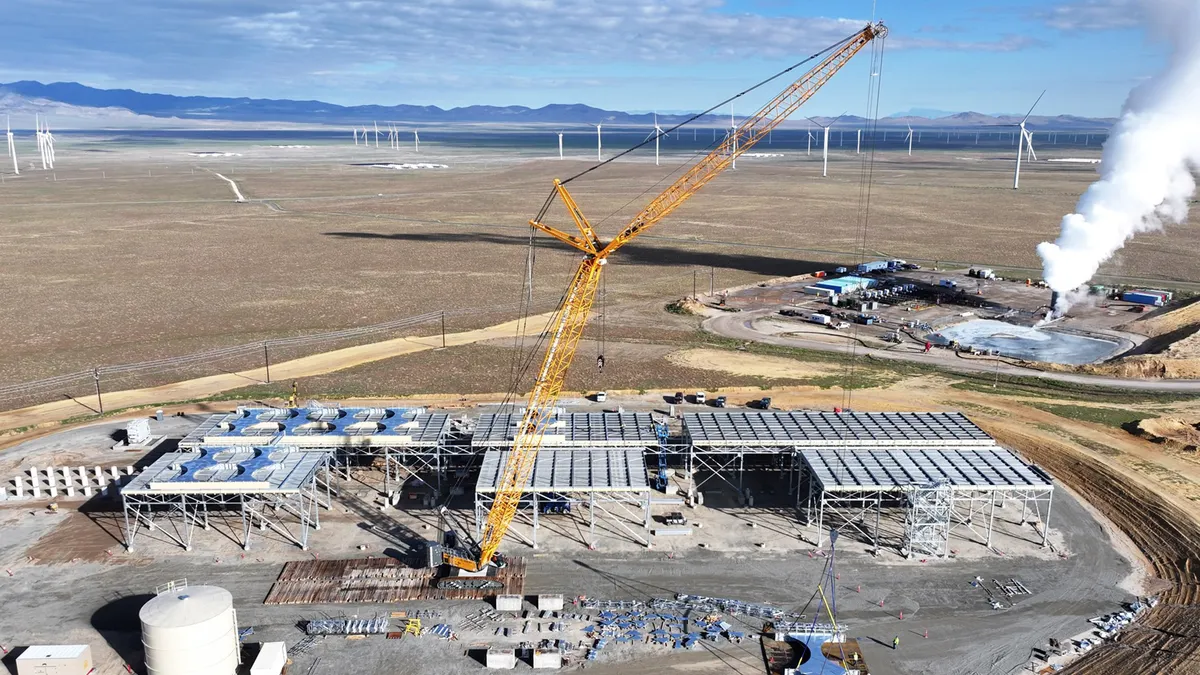
The company has been building a 500-megawatt Cape Station plant in Beaver County, Utah that is expected to begin delivering its first power to the grid later this year. The plant — whose power has been fully contracted — is expected to deliver up to 100 MW by early 2027 and be fully operational by 2028.
Fervo announced it had received $421 million in non-recourse debt financing for the plant in March, a sort of funding its chief financial officer said at the time had “historically been considered out of reach for first-of-a-kind projects” like the Cape Station plant. HSBC, Barclays, JPMorgan and the Royal Bank of Canada participated in that financing.
The company has also raised over $1 billion in funding rounds over the past few years. Fervo closed a $244 million funding round in February 2024 and tallied $255 million in a December 2024 financing round, before announcing fund raises of $206 million and $462 million in June and December 2025, respectively.
Prior funders in those rounds include Google, Bill Gates’ Breakthrough Energy Ventures, venture capital fund B Capital, the California State Teachers’ Retirement System and Liberty Mutual Investments.