Dive Brief:
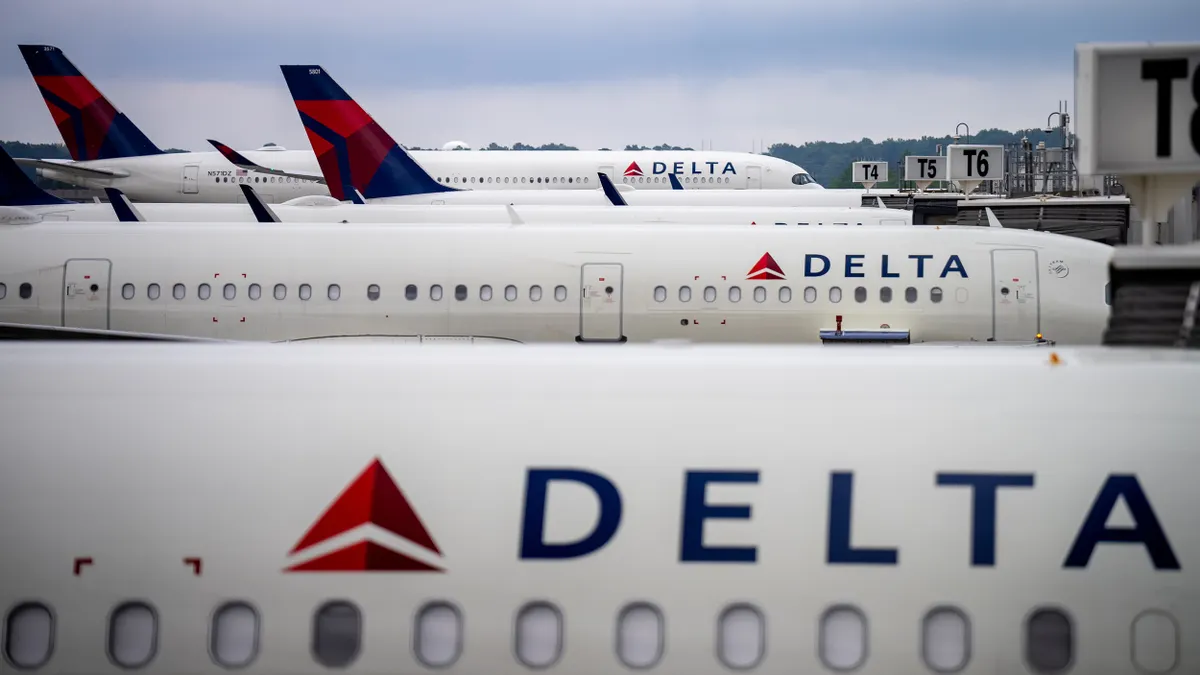
- Delta Air Lines recently reframed its 2050 net-zero target as an “aspiration” on its dedicated sustainability webpage, after previously calling reaching net-zero emissions across its operations by mid-century its “ultimate goal.”
- The company’s sustainability page has also removed references to a 2030 sustainable aviation fuel goal, but a Delta Air Lines spokesperson told ESG Dive Thursday that it remains committed to a goal to reach 10% SAF usage by the end of the decade. Bloomberg first reported the changes on Delta’s webpage earlier this week.
- “Delta continues to see SAF as one of the most important levers for decarbonizing flight and is committed to being a key player in supporting its development,” the airline spokesperson said in an emailed statement.
Dive Insight:
Delta joins several companies that have recently softened their public language around sustainability goals. Google notably began calling its climate targets “moonshots” last year while only 25% of large companies listed on the S&P 100 index used the term “ESG” in their annual sustainability reports in 2024. However, multiple reports have shown that net-zero commitments have increased globally in the past year.
Despite the weakening of language around its 2050 goal, the airline’s spokesperson said “Delta remains committed to [its] 10% SAF by 2030 goal,” noting that the target will also be reflected in the company’s upcoming ESG report.
Delta also has 2050 goals of reaching net-zero emissions across its supply chain and reaching 95% SAF usage in flights, according to its 2024 ESG Report. The airline’s emissions exceeded pre-pandemic levels in 2023, and its overall emissions rose again in 2024, according to last year’s report.
Delta’s decarbonization strategy focuses on making more fuel-efficient aircrafts; using less fuel through optimizations in logistics, drag and aircraft weight; and increasing its use of SAF. The airline reported that its procurement of SAF increased 80% year over year in 2025, having purchased 23.4 million gallons.
“While we have successfully increased use of SAF every year, we recognize that the technology has not advanced as rapidly as the industry or our ambitions require, and this represents potential risk for decarbonization ambitions across the airline industry,” Delta’s spokesperson said.
The SAF market has developed slowly, as sustainable aviation fuels made up just 0.6% of global jet fuel consumption in 2025, even as output nearly doubled, according to the International Air Transport Association. SAF production is expected to slow this year, and IATA estimates that SAFs are expected to make up 0.8% of global jet fuel use in 2026.
Delta Chief Sustainability Officer Amelia DeLuca said on LinkedIn Thursday that while SAF is “one of the most powerful tools” for aviation decarbonization, “it is also one of the hardest to scale — and understand.” She said that scaling the industry will require collaboration.
“It’s all about creating momentum for SAF production and distribution,” DeLuca said. “With the right partnerships, policies and public understanding in place, SAF has every potential to be a powerful driver of a more sustainable future of flight.”