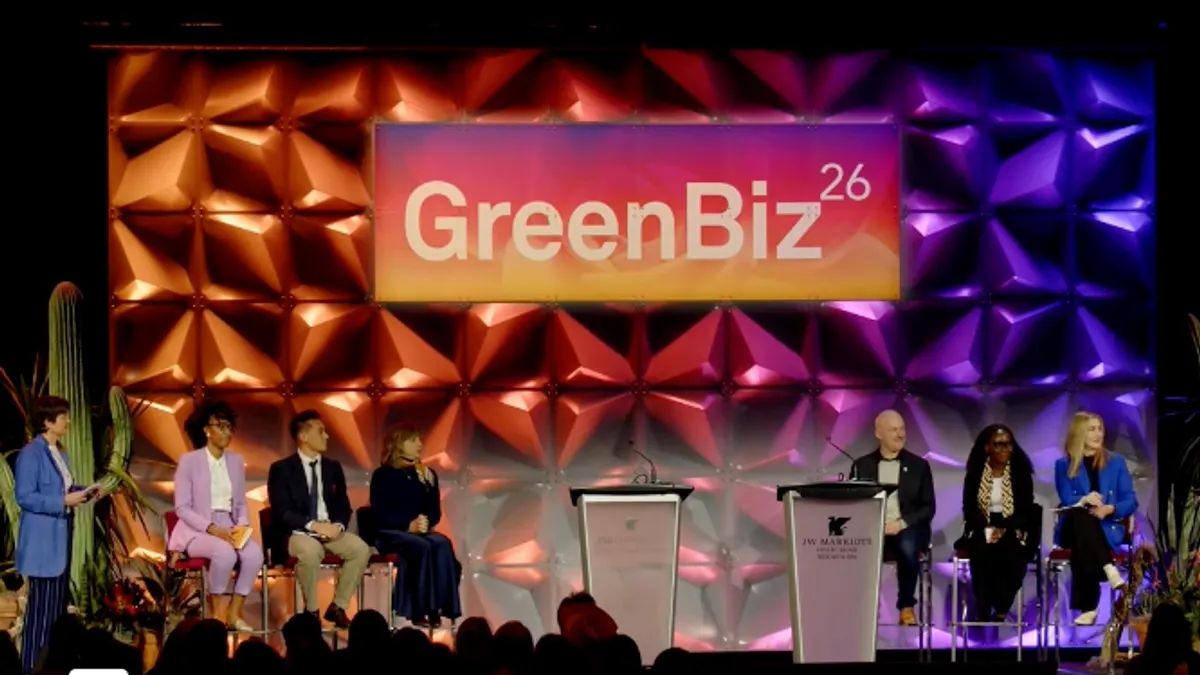
PHOENIX — As thousands of corporate sustainability professionals gathered in Arizona’s capital to share insights following a year of federal policy shifts, the opening day of GreenBiz26 questioned whether the role of chief sustainability officer is still fit for purpose or, “is the role of the CSO dead?”
The question was the crux of a mock debate held during the opening keynote at the Trellis-hosted annual conference of sustainable business leaders. Sophie Lambin, founder and CEO of sustainability-focused research and communications agency Kite Insights, co-hosted the session with Trellis CEO Joel Makower as part of Kite Insights’ “Debatable” initiative. The session comes at a time when U.S. CEOs are increasingly looking to de-prioritize sustainability as an objective in 2026, according to a recent survey.
Sustainability professionals from Universal Music Group, information technology services provider Okta and an environmental justice think tank were asked to argue that the role of CSO was dead, with experts from HSBC, E.L.F. Beauty and the World Wildlife Fund arguing against the notion.
“This debate is not whether CSOs currently lead critical work in the organization or in the communities, nor does it question whether companies have a critical role to play the responsibility in driving sustainability forward,” Lambin said.
“The intent, in fact, is quite the opposite,” she continued. “It’s to ask, when sustainability becomes so politically charged, when organizations start pulling back or going quiet, what happens to the leaders who are expected to keep it moving?”
While it's unsurprising the conference of sustainability professionals ultimately disagreed with the notion, the thought exercise unveiled insights on the evolution of the role.
The case for the death of the CSO
The case for the CSO role no longer being fit to serve corporate sustainability strategy centered on the idea that the role now encompasses too many functions to remain as is, especially as the field has evolved over time.
UMG Senior Vice President and Head of Sustainability Dylan Siegler argued that while it was helpful at one point to centralize under a singular C-suite sustainability leader, the effectiveness of the model has decreased as it became more mainstream across the corporate ecosystem.
“We started out as innovators with a clear purpose, and we've ended up being stretched too thin to create change,” Siegler said. “We really need to think hard about whether one person across the entire strategy is the way to do this.”
Alexa White, environmental justice activist and founding partner of health equity research consultancy Ase Analytics, said that “accountability follows power” and sustainability strategies must be modeled by finance teams, enforced by legal counsel and built by revenue generation teams.
White, also the co-founder of environmental justice think tank Aya Research Institute, argued the role is no longer relevant, “not because sustainability doesn't matter, but because survival-led climate accountability must sit with the executives who control the capital, the risk and the revenue.”
“When climate governance is delegated to a CSO, legal accountability becomes fragmented,” White said. “Climate transition is a commercial risk and revenue leaders have to really own that.”
Michael Chen, who manages Okta’s workplace sustainability program, said driving corporate sustainability strategies forward today requires leaning on teams and roles who don’t have sustainability in their title.
“No one can drive a sustainable net zero target by 2030 alone,” said Chen, whose role resides within Okta’s real estate team. “They need a whole village … to be able to drive that forward and be able to pull levers of influence with folks who don't have sustainability in their title.”
Why companies still need a CSO
On the other side of the debate, experts argued that without a chief sustainability officer owning a company’s sustainability strategy, the integration of sustainability-focused objectives and programs across corporate functions would be haphazard.
“It's a critical function to be an integrator as the chief sustainability officer,” WWF Global Water Stewardship Lead Alexis Morgan said. “Nobody in a company … has as long-term a vision as a chief sustainability officer. They are there to think about the opportunities of tomorrow.”
E.L.F. Beauty Sustainability Reporting Manager Olubamise Onabanjo said while every company doesn’t need a CSO, the role “becomes relevant as a company's business and operations grow, supply chains become more complex and stakeholders increase.”
“The CSO serves as a compass and an accountability partner, strategizing with executive leadership in conversations where overall corporate direction and strategy is formed,” Onabanjo said. “This allows for an advocate amplifying sustainability conversations in traditional business deliberations.”
“Because if sustainability considerations are introduced late, they become constraints, but when they are introduced early, they become strategy,” the E.L.F Beauty executive added.
HSBC Americas Head of Corporate Sustainability Kelly Windsor Fisher said that the role of a CSO is “more relevant than ever.”
“The business world's metaphorical roof is about to cave in from the weight of climate change,” she said. “We know that strong sustainability strategies generate tangible business results and tackle those physical risks, but in 2025 public and private climate programs have been either scaled back or ended.”
Windsor Fisher questioned not whether CSOs are irrelevant, but whether they have “been given the proper tools to succeed.” She pointed to a 2022 PricewaterhouseCoopers report that found that “roughly half of all CSOs are two or more hierarchy levels below the C-suite.” However, she added that “barriers are not a sign of irrelevance.”