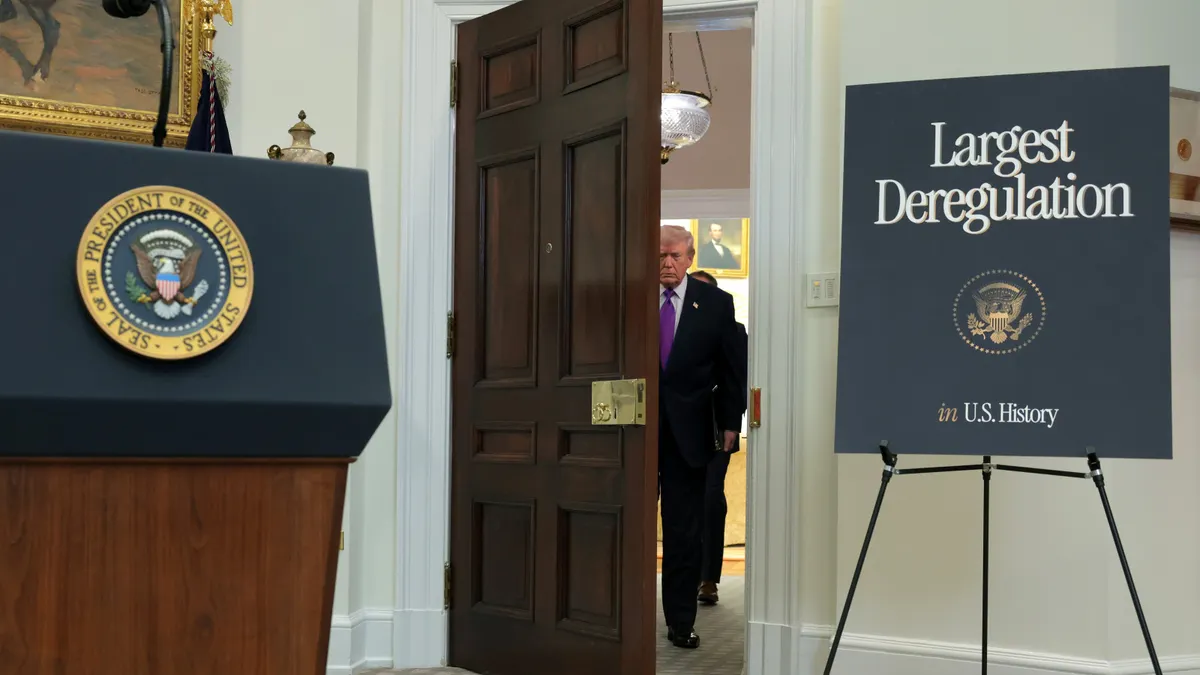
2025 was an eventful year in the ESG space. President Donald Trump’s return to the White House set the stage for a year of deregulation, exits from landmark climate agreements, reversal of sustainable initiatives and more.
While federal agencies, including the Securities and Exchange Commission, worked to overturn, withdraw or stop defending Biden-era policies focused on ESG, the evolving political environment has also caused companies to recalibrate how they communicate climate goals and objectives.
As the new year begins, ESG Dive has compiled the top trends companies and sustainability leaders should keep an eye on for 2026.
How the SEC climate rule returning to agency hands impacts reporting
Trump’s November 2024 reelection was expected to usher in federal deregulation of climate and ESG issues, and he delivered it within the first year of his presidency. The Securities and Exchange Commission, under Chair Paul Atkins, was among the agencies that worked to distance themselves from Biden-era rulemaking.
The SEC stopped defending its climate-risk disclosure rule in court and later scrapped a variety of other rules proposed under prior agency leadership. Among the discarded proposals was a rule that would have required increased disclosures for ESG and similarly labeled funds and a rule to alter the shareholder proposal and resubmission process.
However, after refusing to say whether the agency would uphold the rule if it survived litigation, the federal judge overseeing the challenges stayed the rule and kicked it back to the agency, according to court documents. Now, the SEC will have to determine whether to reconsider the rule under notice and comment or renew its defense of the rule in court, according to a September order.
Disclosure requirements and reporting are here to stay
Ultimately, the regulatory landscape companies face in 2026 looks different than it did in 2025. U.S. companies that were expecting to report under the European Union’s Corporate Sustainability Reporting Directive or Corporate Sustainability Due Diligence Directive California’s climate disclosure laws — Senate Bills 253 and 261 — are facing changes.
“The regulatory imperatives are changing somewhat,” Derrick Flakoll, a senior policy associate for North America at BloombergNEF, said in an interview.
The European Union sits on the precipice of removing a bulk of companies from the scope of its sustainability laws. The European Council and European Parliament reached a political agreement last month to alter the CSRD and CSDDD that lawyers at Ropes & Gray estimate will remove around 90% of companies from the CSRD’s scope and 70% of companies from CSDDD compliance. The agreement passed Parliament and awaits approval by the European Council.
California’s climate disclosures are live — sort of. The laws, SB 253 and 261, were initially signed in 2023 and have faced legal challenges since crossing Gov. Gavin Newsom’s desk. A federal appeals court temporarily halted enforcement of the climate-risk disclosure law, SB 261, in November and, currently, prepares to hear arguments in the case.
However, dozens of companies have already voluntarily submitted financial-risk reports, according to a database maintained by the state agency in charge of implementation. The emissions reporting rule for companies with over $1 billion in revenue, SB 253, remains unblocked, though the state is not expected to take enforcement actions in the first year of reporting.
Despite the federal rollback and EU simplification efforts, large U.S.multinationals will still have to comply with a growing global disclosure regime. Climate disclosure laws in Australia and Spain go live this year, and Ropes and Gray Partner Michael Littenberg said in a Jan. 7 blog that he expects climate disclosure requirements to increase this year.
Green economy continues to grow
Despite political headwinds, the green economy topped $5 trillion in annual value last year, according to a report from the Boston Consulting Group and the World Economic Forum. The same report found that decarbonization solutions, including industrial energy efficiency and solar, wind, hydropower and nuclear power and heating are already cost-competitive solutions “in most cases or soon-to-be.
“Recent headlines may suggest that the climate transition is stalling. Yet, overall growth in the green economy has not wavered,” WEF Executive Committee Head of Climate and Nature Economy Pim Valdre and BCF Managing Director Patrick Hernold said in the report’s foreword.
“On the contrary, investments in green technologies keep jumping from record to record,” Valdre and Hernold said.
The market for “commercial solutions with a clear environmental purpose or solutions that are a direct response to environmental challenges,” including adaptation, resilience and mitigation measures, is expected to reach $7 trillion annually by the end of the decade.
Businesses have decided to largely maintain the course on sustainability, amid the political backlash. Last year also saw a growing number of the world’s largest companies commit to reaching net-zero, and 41% of the world’s 2,000 largest companies have net-zero targets for their entire supply chain, according to a recent Accenture report.
Companies are adjusting their corporate communication around ESG and sustainability
The terms “ESG,” “climate change” and “sustainability” have become highly politicized in recent years, often landing in the fine print of contentious lawsuits, state-led probes and federal deregulation actions.
Though these terms were already the target of scrutiny, they have found themselves in the center of the crossfire under the current presidential administration.
Experts previously told ESG Dive that Trump’s return to the White House, bolstered by a Republican majority in both the House and Senate to boost his legislative agenda, has created an overall atmosphere of fear and uncertainty that most companies — especially financial institutions — want to steer away from. In the months leading up to and after Trump’s January 2025 inauguration, many banks withdrew from climate alliances and groups in the wake of ongoing political scrutiny.
As a result, several companies and firms have increasingly pivoted away from publicizing their sustainability efforts and resorted to “climate hushing” or “greenhushing.” Both terms describe the phenomena of companies deliberately downplaying, concealing or refraining from publicly announcing their progress on climate goals to safeguard themselves from potential criticism or backlash.
A report from the Conference Board last year found that companies have been adjusting their communications around ESG to adapt to the political environment. The April report found that only 25% of large companies listed on the S&P 100 index used the term “ESG” in their annual sustainability reports in 2024, a sharp decline from the 40% of companies that used it in 2023. From the companies that reported by the time the Conference Board’s analysis was published, only 6% used the term in their sustainability reports.
“We have seen companies [be] more quiet on what they're doing in sustainability and decarbonization over the last year than they've ever been on this topic,” David Linich, a partner at PricewaterhouseCoopers overseeing its decarbonization and sustainable operations in the U.S., told ESG Dive in an interview.
However, Linich said that despite the optics, companies are still pursuing climate and sustainability goals with “a steady level of commitment,” pointing to a study that PwC conducted that evaluated over 4000 companies globally.
“In this area of climate, we find more companies are increasing their ambitions than are decreasing their ambitions,” he added. “You still see companies issuing sustainability reports, and they're also being asked by many of their customers to share more information around what they're doing.”