Dive Brief:
- A federal judge ruled last week that New York cannot enforce a law that would have required fossil fuel companies to pay the state billions of dollars based on their historic carbon footprint.
- The Climate Change Superfund Act, enacted by New York Gov. Kathy Hochul in 2024, applied to oil and gas companies that emitted more than 1 billion metric tons of greenhouse gases between 2000 and 2018 (later updated to 2000 through 2024), and required these companies to pay $75 billion over 25 years.
- Judge Brenda K. Sannes of the Northern District of New York wrote in an Aug. 31 decision that the law is preempted by the Clean Air Act, a federal law that regulates air emissions. Sannes added in her 63-page opinion that the Superfund Act went “beyond the limits of state law” and operated “within an area of law ‘in which the federal interest is so dominant’ that it cannot be enforced.”
Dive Insight:
The law was modelled after the federal Superfund program — or the Comprehensive Environmental Response, Compensation, and Liability Act — created in 1980 with the aim of holding companies responsible for their hazardous waste and preventing toxic waste disasters. The program eventually served as a blueprint for statewide climate policy, spurring “superfund” laws in Vermont, New York, Maine and other states.
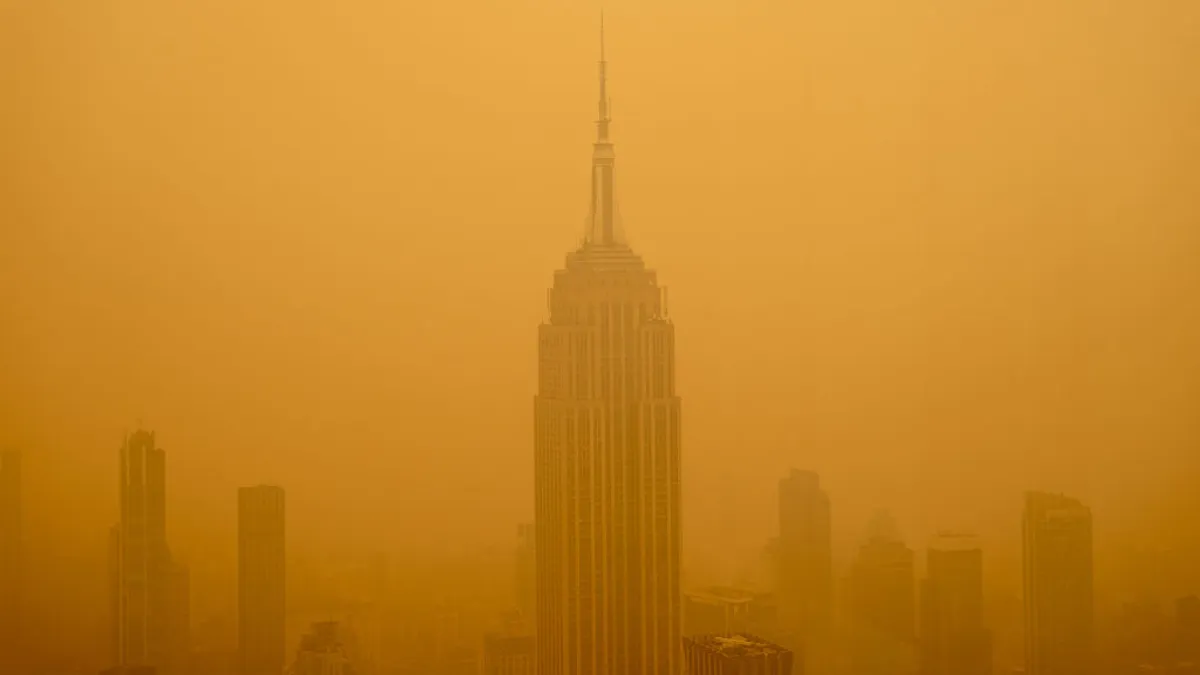
When passed in December 2024, the Climate Change Superfund Act aimed to back projects in New York that boosted the state’s resiliency to climate-related disasters like heatwaves and flooding. The establishment of the superfund also intended to shift the price tag of the state’s climate adaptation from New Yorkers to “the fossil fuel companies most responsible for the pollution,” Hochul’s office said in a press release announcing the signing.
“With nearly every record rainfall, heatwave, and coastal storm, New Yorkers are increasingly burdened with billions of dollars in health, safety, and environmental consequences due to polluters that have historically harmed our environment,” Hochul said at the time. “Establishing the Climate Superfund … hold[s] polluters responsible for the damage done to our environment and requiring major investments in infrastructure and other projects critical to protecting our communities and economy.”
The law was met with opposition from several Republican-led states, trade and business organizations and the Trump administration, who challenged the law and a similar one that passed in Vermont.
The initial lawsuit was filed in February 2025 by a coalition of attorneys general from 22 Republican-led states, headed by West Virginia, who argued that New York was overstepping by attempting to penalize out-of-state energy production and dictate national energy policy.
The AGs were joined by business and energy trade groups, including the U.S. Chamber of Commerce, the American Petroleum Institute, the National Mining Association and the Business Council of New York State, who filed a separate lawsuit alleging similar concerns. Both cases were later consolidated into a single suit. Once combined, the suit received further support from the U.S. Justice Department, which filed a statement of interest and presented oral arguments to back the plaintiffs.
In May 2025, the Trump administration filed its own lawsuit against New York, alleging that the state’s superfund law was unconstitutional and had been enacted as a “transparent monetary-extraction scheme” to force out-of-state fossil fuel companies to fund New York’s climate change adaptation projects.
In her ruling last week, Sannes sided with the Republican state AGs and business organizations and said the superfund’s “unusual and sweeping statute” conflicted with federal law. The judge’s opinion frequently referred to a 2021 appeals court ruling which determined that New York City could not sue oil companies under state law for damages related to climate change.
The decision is the latest example of the ongoing disconnect between state- and federal-level policy when it comes to climate change adaptation laws and corporations’ responsibility for their carbon emissions. The case also shows how the Trump administration is enforcing its executive order on state-level emissions and ESG policies.