Dive Brief:
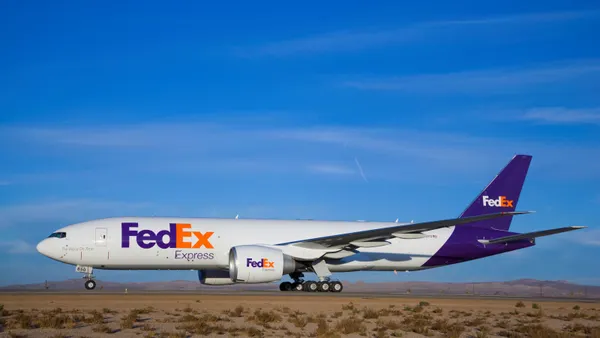
- FedEx has signed a series of agreements to expand its procurement of sustainable aviation fuel across five airports in the United States, the company announced Tuesday. The deals are projected to deliver over 20 million gallons of neat or unblended SAF through 2027.
- The SAF agreements will span FedEx operations at Newark Liberty International Airport, John F. Kennedy International Airport, Dallas Fort Worth International Airport, Oakland International Airport and Miami International Airport, according to a Sept. 15 release. The shipping company said the SAF will be delivered in blended ratios ranging from 30% to 50%.
- FedEx has a goal to purchase 30% of its jet fuel from alternative sources by 2030 and said in the release it is working to scale the use of SAF across its U.S. air network. The company didn’t disclose suppliers or financial details of the agreements.
Dive Insight:
The global shipping and logistics giant has a target to reach carbon neutrality by 2040. FedEx also aims to decrease its aircraft emissions intensity by 40% by 2040, compared to a 2005 baseline.
As it owns a big portion of its transportation assets, FedEx’s scope 1 emissions generate the largest portion of its carbon footprint. About 80% of its scope 1 emissions are from jet fuel use alone, according to its website.
“SAF is one of the most impactful decarbonization solutions available to aviation today and an important part of our approach to reducing emissions,” said FedEx Chief Sustainability Officer and Vice President of Environmental Affairs Karen Blanks Ellis in the Tuesday release. “Expanding our procurement allows us to employ more SAF in our network while bolstering the demand for greater production and scale.”
SAF has the potential to reduce lifecycle carbon emissions by up to 80% compared to conventional fossil kerosene, according to the Air Transport Action Group. However, the International Air Transport Association found that SAF use made up just 0.6% of global jet fuel use in 2025 and is expected to provide only 0.8% of jet fuel consumption this year. Although SAF production doubled last year, its growth is expected to slow this year, according to IATA.
Earlier this year, FedEx said it had expanded its use of SAF to five airports in the U.S., following its deployment of blended SAF at Dallas Fort Worth International Airport and John F. Kennedy International Airport in 2025. The SAF deployment at DFW and JFK was part of a deal FedEx made with World Fuel Services, which committed to deliver 2 million gallons of SAF at the two airports.