Dive Brief:
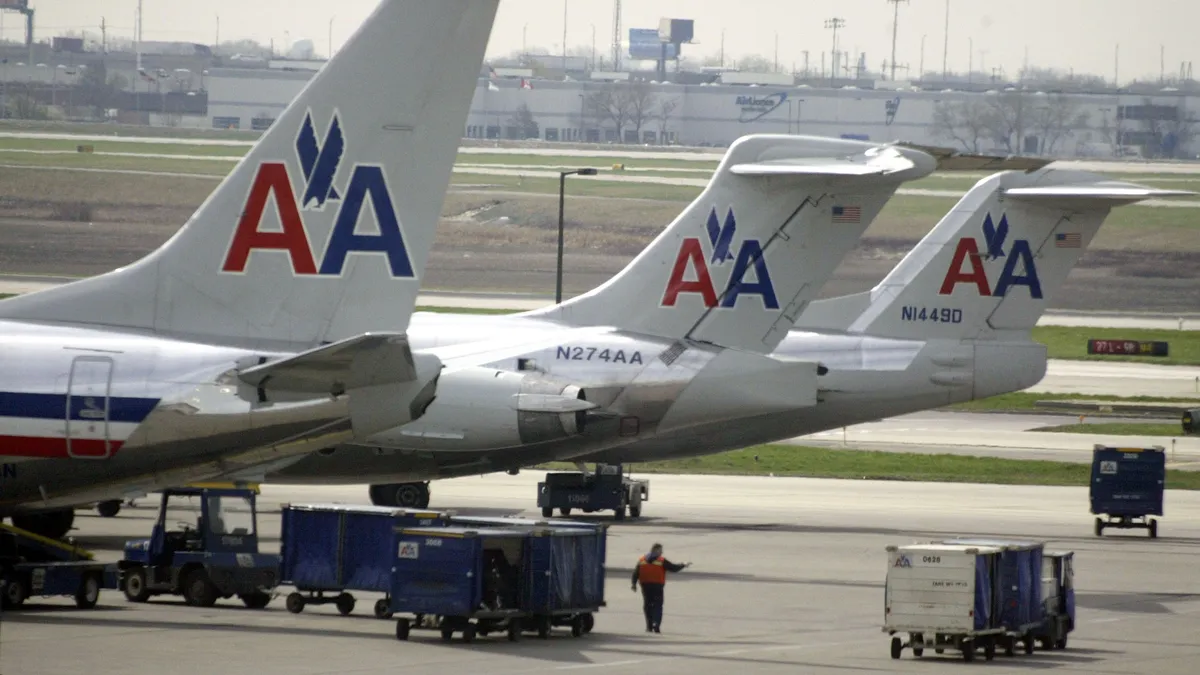
- Google and American Airlines announced an agreement Tuesday that will allow the airline to purchase 35 million gallons of sustainable aviation fuel and provide the tech giant with SAF certificates to help offset employee travel emissions, according to a press release.
- With the support of the underlying agreement, American Airlines said that it signed a new SAF offtake deal with Valero Marketing and Supply Company. The purchased SAF is expected to reduce 300,000 metric tons of emissions, with Google receiving the environmental attribute benefits over the course of the three-year deal. Financial terms of the deal we not disclosed
- American Airlines called it a “record-breaking agreement” for SAF certificates, and said it was the largest publicly announced deal for SAF certificates “between an airline and a single corporate customer to date.”
Dive Insight:
American Airlines CEO Robert Isom expressed concerns in the company’s 2024 ESG report about the pace of decarbonization in the aviation industry, as well as American Airlines’ ability to reach its interim climate goals and its 2050 net-zero target. Sustainable aviation fuels made up just 0.6% of global jet fuel consumption in 2025, according to the International Air Transport Association. Additionally, though SAF production doubled last year, production growth is projected to slow in 2026, and IATA estimates that SAFs will account for 0.8% of jet fuel use this year.
Sustainable aviation fuel can produce up to 80% less emissions than conventional aviation fuel, according to IATA. American Airlines Chief Sustainability Officer Jill Blickstein called the deal with Google “a critical step forward” in reducing the company’s operational emissions that will help grow SAF demand and “support the development of a stronger, more resilient market.”
American Airlines will purchase SAF created from waste like used cooking oils and receive deliveries at Chicago O’Hare International Airport. The deal was also supported by an Illinois state SAF tax credit, American Airlines said in the June 9 press release.
SAF production in the United States increased from 39 million gallons in 2024 to 240 million gallons produced in 2025, and “all that new supply needs to find a home,” according to BloombergNEF Renewable Fuels Analyst Jade Patterson. The U.S. is “an attractive place for corporates like Google to buy SAF” because it is home to “some of the most generous incentives” to cover the cost gap between SAF and traditional jet fuel, he said in emailed comments.
Google will receive and track the SAF certificates through the SAFc Registry, which is a collaboration between the Rocky Mountain Institute, the Environmental Defense Fund, Energy Web and the Sustainable Aviation Buyers Alliance.
Google said in a Tuesday company blog that “multi-year demand signals are critical for scaling production,” and Chief Sustainability Officer Kate Brandt said in the press release that the commitment sends a “a vital demand signal to catalyze investment and bring more SAF to market.”
Google signed its first long-term SAF deal in March with American Express Global Business Travel and Shell Aviation, and has also invested in the creation of a SAF market in Singapore and startups doing related research and technology.
It’s “hard to say” whether other companies will follow Google’s lead, but the increase in registries for SAF certificates makes it easier for other corporations to purchase sustainable aviation fuel, BloombergNEF’s Patterson said.
“When it comes to reaching net-zero, SAF is really the only option available right now,” Patterson said. “So if companies are serious about reaching their targets then we could see more follow this trajectory. Additionally, buying SAF certificates is seen as more sustainable than buying offsets in another sector … because it helps scale a technology that could decarbonize the entire sector if adopted more broadly.”