Dive Brief:
- Geothermal company Fervo announced it closed a $462 million funding round Wednesday to help build out a 500-megawatt Utah project, expected to be fully online by 2028, along with other projects in its pipeline.
- Venture capital firm B Capital led the financing, which exceeded Fervo’s target close amount, according to the press release. Google, Bill Gates’ Breakthrough Energy Ventures, automaker Mitsubishi’s heavy industry business and the California State Teachers’ Retirement System also participated in the latest funding round.
- The Department of the Interior has given Fervo the green light to deploy up to 2 gigawatts of power at its Cape Station project in Beaver County, Utah. The company previously closed a $255 million financing round last December and another $206 million funding round in June to support the project’s development.
Dive Insight:
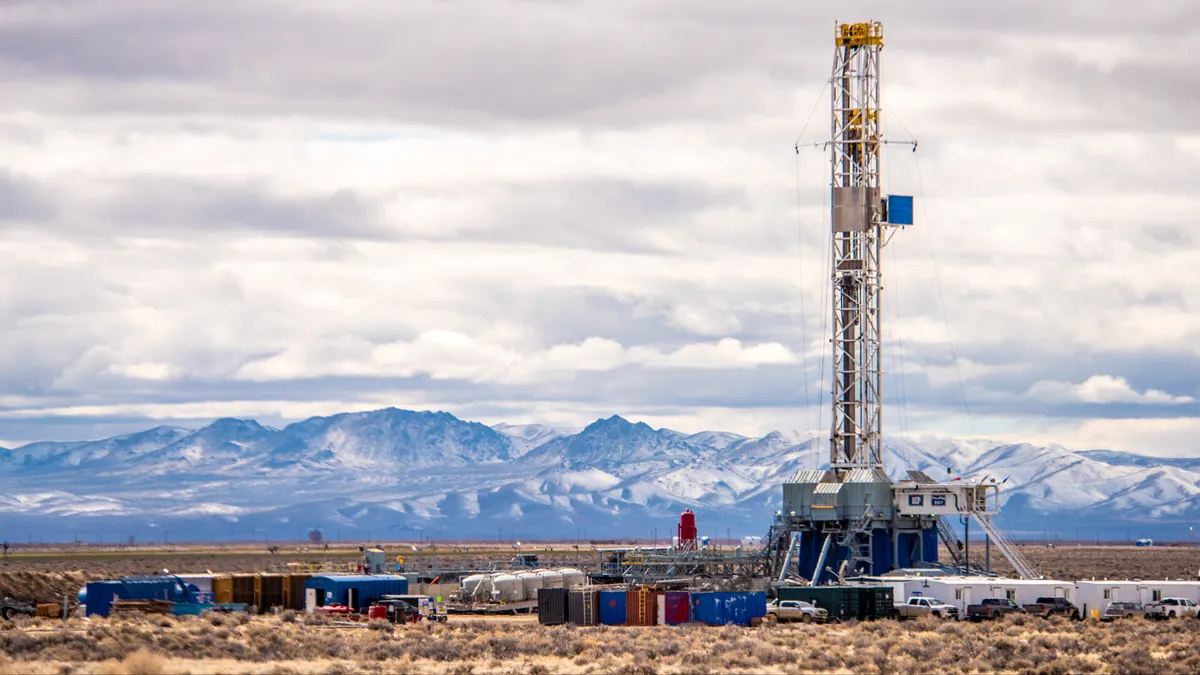
Fervo aims for its Cape Station project to be the “world’s largest next-generation geothermal development,” according to the project’s website. A next-gen geothermal plant uses advanced drilling methods to access the Earth’s heat beyond its natural hot spots by creating artificial reservoirs or reaching deeper, hotter zones, according to BloombergNEF. The process requires minimal land use.
The Cape Station project will be developed in multiple phases, with the first completed state expected to deliver 100 MW of carbon-free electricity to the grid in 2026. A second phase is expected to deliver an additional 400 MW of power beginning in 2028.
The Houston-headquartered company said in the release that construction on the Cape Station facility is “progressing rapidly,” and Fervo CEO Tim Latimer said the funding announced this week “sharpens” the company’s pathway “from breakthrough technology to large-scale deployment.”
“Energy markets are demanding dependable, carbon-free power at an unprecedented scale, and Fervo is uniquely positioned to supply it,” Latimer said in the release.
Google and B Capital made their first investments in Fervo this funding round, and seven other new investors joined the funding round. The funding round was also supported by first-time investors Netherlands-based impact fund Carbon Equity, VC firm Climate First, mineral and metal resources company Mitsui & Co., the founder of nuclear technology company Holtec International, Atacama Ventures, AllianceBernstein and former Tesla Motors Chief Technology Officer JB Straubel.
“With surging demand from AI and electrification, the grid urgently needs scalable, always-on solutions, and we believe enhanced geothermal energy is uniquely positioned to deliver,” B Capital General Partner Jeff Johnson said in the release.
This spring, Fervo signed an offtake agreement with energy giant Shell and expanded the original plans for the Cape Station facility to 500 MW, the latter enabled by technological advances. Shell Energy signed a 15-year power purchase agreement to receive 31 MW of geothermal power, which it will use for retail load customers beginning in 2026, according to an April release. Fervo said 500 MW of capacity from the plant are fully contracted, following the Shell deal.
The production of geothermal energy still comes at a “minor cost disadvantage,” compared to traditional methods, according to a recent report from Boston Consulting Group and the World Economic Forum.
The deal comes as companies like Meta and Mastercard have inked geothermal deals to drive down their company emissions profile.
Meta recently inked a pair of geothermal deals to power its data centers: the first with Sage Geosystems last year, followed by a deal with XGS Energy in June. Global payments giant Mastercard announced this past Earth Day it was replacing the natural gas-powered heating and cooling system at its Purchase, New York, headquarters with a geothermal-based system.