Dive Brief:
- Amazon released its 2025 sustainability report this month, showing that its absolute carbon emissions increased 16% in 2025. The report found that the tech and e-commerce company’s emissions increased across the board in 2025.
- Amazon’s scope 1 emissions increased 2%, its scope 2 emissions — from purchased electricity — jumped 34% and its scope 3 emissions rose 20% in 2025 from 2024, according to the report. The company also found that its carbon intensity increased slightly, though it remains below a 2019 baseline.
- The artificial intelligence buildout and its related data center expansion also pushed emissions higher at Google and Microsoft in 2025. Amazon’s sustainability data released on July 1, right after Google reported that its emissions increased 18% in 2025 and before Microsoft said its emissions jumped 25%.
Dive Insight:
Amazon has a goal to reach net-zero global greenhouse emissions by 2040, as well as a variety of 2030 goals that include replenishing more water than its data centers consume, halving its U.S. and European operational food waste and reaching at least 100,000 electric vehicle delivery vans.
Amazon’s scope 1 emissions or direct emissions accounted for 19% of its emissions in 2025, scope 2 accounted for 5% of its footprint and scope 3 emissions made up the remaining 76%, according to the report. While its emissions were up across the board, the company reported being 75% of the way to its goal of replenishing more water than its data centers use.
Senior Lead for Sustainability Devon Scott said that the report “reflects the momentum and complexity of this moment in which AI is unlocking solutions at an unprecedented scale while also creating new demands for energy, water, and infrastructure,” in a July 1 company blog.
While the company reported a 3% increase in its carbon intensity — measuring how many grams of carbon dioxide equivalent the company emits per dollar in revenue — in 2025, Amazon said its carbon intensity is still 38% below a 2019 baseline. It said that the sustained decrease has come alongside 156% revenue growth since 2019 including a 12% increase in revenue growth in 2025.
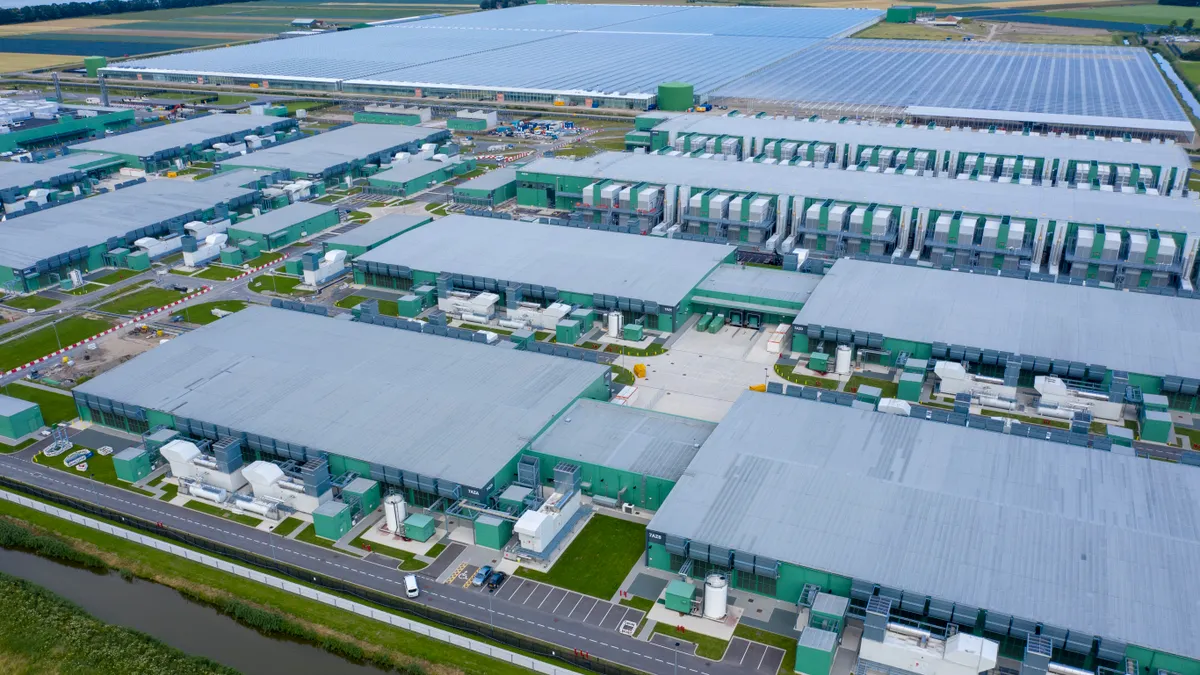
Amazon reported adding more data center capacity globally in 2025 than any other company, including over 1.2 gigawatts of capacity in the final quarter of the year, and said it expects “AI and cloud services to continue growing.” The company said its electricity use in data centers — along with the electrification of its fleets and buildings — pushed its scope 2 electricity higher last year.
The company said in its sustainability report that it reached a pair of 2025 renewable energy goals to match the energy use of its global Echo, FireTV and Ring devices and all of its global energy consumption with renewable energy.
Amazon’s scope 3 emissions, which also jumped in 2025, includes the construction of its data centers, as well as production of its products and hardware and the fuel consumption of any third-party transportation partners. The company said it’s engaging its suppliers to get them to set targets and reduce emissions, working to scale low-carbon materials in data center construction and the use of lower-carbon fuels in its logistics network.
“We recognize that the path to being a more sustainable company is not a straight line,” Amazon said in the report. “Though our emissions increased in 2025, we remain steadfast in our commitment to sustainability.”
As a giant in the tech and e-commerce spaces, Amazon’s latest sustainability report also documents ways the company is looking to address packaging topics like materials, shipping labels and other related systems. The company reported it reduced its carbon emissions per unit shipped by 7% in 2025.
Amazon, which also owns Whole Foods and other grocery brands, also reported meeting 33 of 35 materials and agricultural sourcing goals it had for 2025. Among them include sourcing goals to eliminate deforestation, as well as those related to sustainable seafood and agriculture.
While the company reported sourcing all of its palm oil and derivatives in its Whole Foods Market and Amazon Private Brands in Europe from certified sustainable sources, it reported sourcing 94% of its palm oil and derivatives in its North America private brands from certified sustainable sources.
Additionally, Amazon remains a ways off from achieving its goal of moving from conventional to recycled polyester in its apparel products. The company reported 17% of its apparel products were made with recycled polyester in 2025, up from 15% in 2024.