Dive Brief:
- Microsoft released its 2026 environmental sustainability report on Friday, which found that the company’s total emissions increased by 25% year-over-year during its 2025 fiscal year as the artificial intelligence buildout continues.
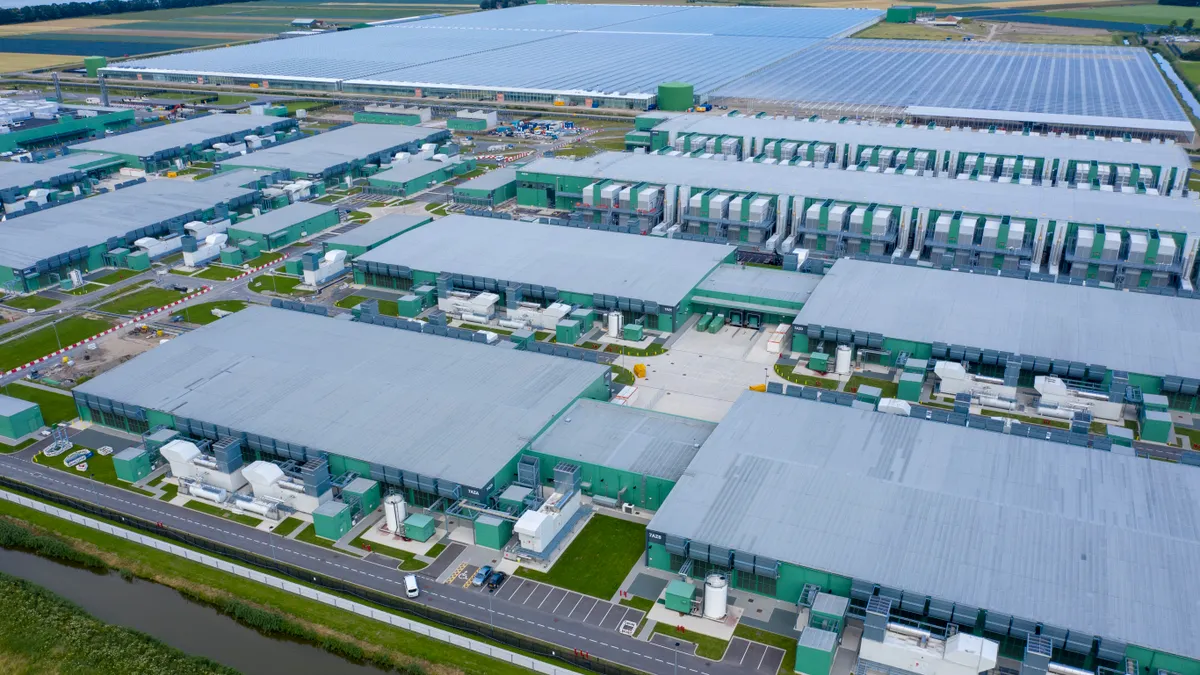
- The tech giant said the increase in emissions was “primarily driven” by the expansion of data center infrastructure, along with it no longer using “non-additional” unbundled renewable energy certificates — which are not tied to a specific project. Microsoft reported its scope 2 emissions increased from 2% of its total emissions in the prior fiscal year to 13% of its total emissions in FY2025.
- Microsoft said that its latest results “reflect both progress and pressure,” adding that AI is “driving demand for energy, water, land and materials,” though “sustainability solutions are not scaling fast enough to meet demand.” However, the company said the tension between those two facts is “productive.”
Dive Insight:
Microsoft reported emitting 20.29 million metric tons of carbon dioxide equivalent in FY2025, up from the 16.21 million metric tons of CO2 equivalent emitted the year prior. Without the use of unbundled RECs, the company’s market-based scope 2 emissions — emissions generated from electricity purchased through specific power contracts and energy-attribute certificates — ballooned to nearly 2.7 million metric tons of CO2 equivalent last year from 258,217 metric tons of CO2 equivalent in FY2024.
The report’s foreword — written by Microsoft Vice Chair and President Brad Smith and Chief Sustainability Officer Melanie Nakagawa — said that the proliferation of AI is “reshaping economies, accelerating innovation and becoming foundational to how technology is built and used.”
“As we scale the physical infrastructure required to power the AI economy, our emissions are shaped by the impact of that growth and the actions we are taking to manage it,” they wrote.
The increased adoption of AI “is also increasing demand for the energy, water, land, and materials required to support that growth,” Smith and Nakagawa wrote. “As a company at the forefront of this transition, Microsoft has a responsibility to help ensure that technology strengthens, rather than strains, the systems and communities on which it depends.”
Microsoft estimated that it would have emitted over 34 million metric tons of CO2 equivalent without interventions like increasing the energy efficiency of its Xbox consoles; purchasing certificates for renewable energy, sustainable aviation fuel and sustainable marine fuel; and supply chain decarbonization work on its Surface tablets.
Despite no longer using unbundled RECs, Microsoft reported matching all of its annual global electricity consumption with renewable energy, and expanding its renewables portfolio to include agreements for up to 40 gigawatts of new renewable energy in 26 countries. The company was able to match its electricity use with renewables using on-site generations, power purchase agreements, green power products and other long-term contracts, while renewables purchased for scope 3 accounting purposes were excluded from that calculation.
Earlier this year, Microsoft rebuffed reports that it had paused its carbon removal program, with Nakagawa telling ESG Dive at the time that its carbon removal program had “not ended.” The company announced another carbon removal purchase shortly after those reports.
Microsoft was responsible for over three-quarters of disclosed contracted carbon removal purchases as of April 13, according to a report from CDR.fyi, acarbon dioxide removals registry and data analytics platform. Microsoft said it contributed to more than 45 million metric tons of carbon removal during the 2025 fiscal year, investing in 29 projects across 10 removal pathways.
Microsoft’s latest sustainability report comes a few weeks after the tech giant announced it had replenished more water than it used during FY2025. The company has 2030 goals of becoming carbon negative, replenishing more water than it uses and reaching zero waste across its direct operations products and packaging.
The report also comes after fellow tech giant Google reported a rise in emissions due to its own AI buildout.