Dive Brief:
- Microsoft said it replenished more water than its operations used in its 2025 fiscal year, the tech giant announced in a company blog Wednesday. The company has a goal to become “water positive by 2030.”
- The tech giant said it reached the goal by “decoupling data center growth from water use,” adding that its data centers are using water 25% more efficiently than a 2022 baseline.
- The announcement comes amid growing concerns and pushback against data centers over their environmental and social impacts. Earlier this year, Microsoft announced that it would look to take a “community first” approach to artificial intelligence infrastructure, which includes a plank focused on minimizing water use and replenishing more than it uses.
Dive Insight:
In addition to having a goal to replenish more water than it uses by the end of the decade, Microsoft has 2030 goals of becoming carbon negative and improving the water use intensity of its data centers by 40%, from a 2022 baseline. Microsoft said its current generation of data centers use 90% less liters of water per kilowatt hour than its first generation data centers.
In 2023, the World Resources Institute found that over half of the global population lives under “highly water-stressed conditions for at least a month each year,” and that nearly one-third of the global gross domestic product, $70 trillion, will face exposure to “high water stress” by 2050.
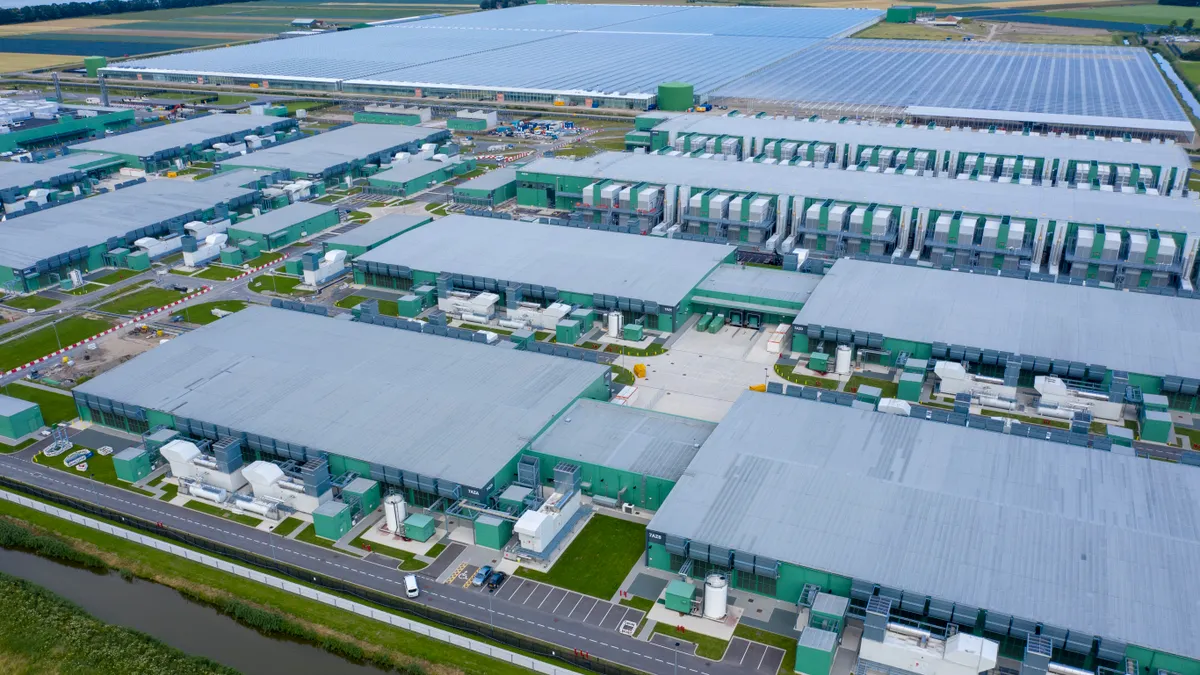
Microsoft said that 90% of its 2025 fleet used what it calls “low-water” or zero-water cooling systems, with the remaining 10% being legacy data centers that use cooling towers. Additionally, the company has increased its reliance on recycled, reused or non-potable water across various data centers globally.
Beyond increasing its water use efficiency, the company has invested in community projects to deploy early leak detection to aid local water reliability and restore wetlands to enhance the natural reservoirs as part of its water replenishment efforts, according to the blog. Microsoft said it has also invested more than $500 million across 75 water and wastewater projects since 2020, with a focus on delivering measurable community benefits, to aid its water stewardship efforts.
U.S. data centers directly consumed 66 billion liters of water in 2023, with hyperscalers expected to directly consume between 60 and 124 billion liters of water by 2028, according to a 2024 study. Indirectly data centers used nearly an additional 800 billion liters of water through electricity use in 2023.
The legacy data centers are estimated to use around 200-300 million gallons of water annually for cooling. Cooling for the rest of the fleet ranges from 90 to 100 million gallons annually for hybrid fluid cooling systems, up to 80 million gallons annually for direct cooling systems and no water for certain systems.
The tech giant said that the primary cooling method for its data centers is direct air cooling with evaporative assist, meaning it uses outside air to cool the machines and leverages water evaporation. Microsoft said the method uses up to 90% less water than traditional water-based cooling systems and only uses water cooling in situations where the outside temperatures are greater than 85 degrees Fahrenheit.
The tech giant also said it introduced zero water cooling systems through new data center designs in 2024. The company said the design is optimized for AI workloads and uses chip-level cooling and recirculates water as part of its cooling system.
Microsoft’s community-focused AI infrastructure plan also includes paying utility rates high enough to offset its electric costs, creating local jobs, adding to the local tax base and investing in local AI training and nonprofits.
“Data centers are essential infrastructure for the digital economy, and we believe they should be built and operated in ways that benefit the communities they serve,” Microsoft said in the blog.
The announced water milestone came a day after United Nations Secretary-General António Guterres called on “every major AI company” to measure and disclose their emissions, water and land use footprints and power all AI data centers with renewables by 2030.