Dive Brief:
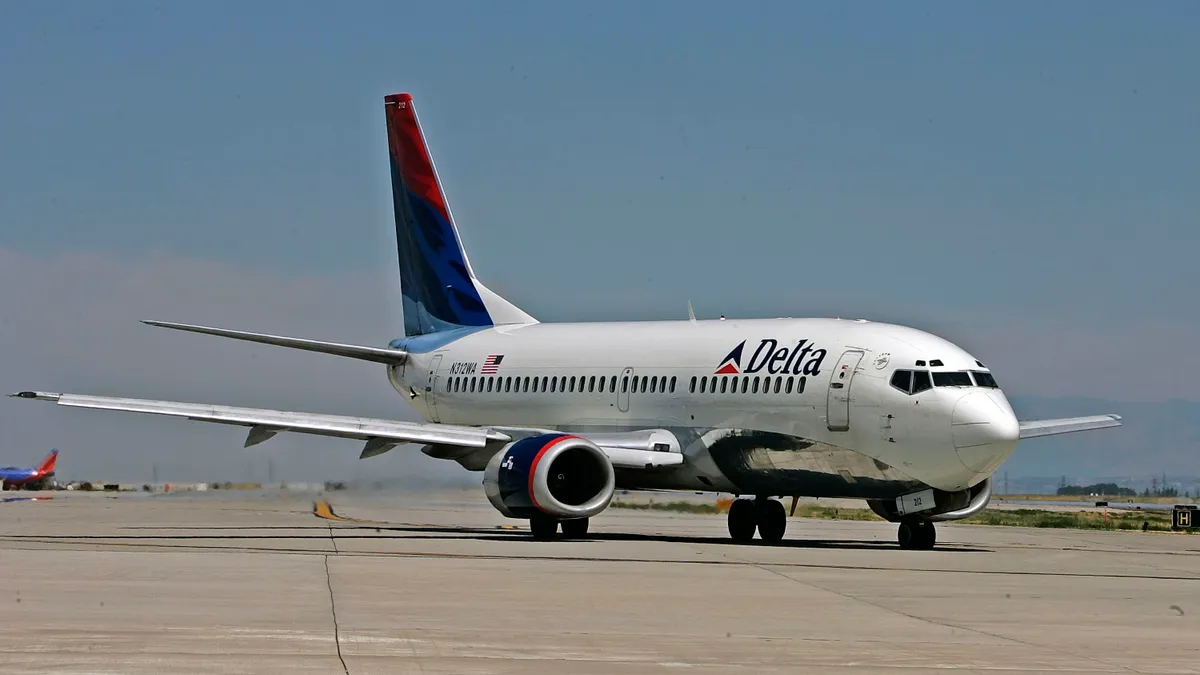
- Delta Air Lines and Shell have entered a five-year agreement to expand sustainable aviation fuel capacity and infrastructure at five U.S. airport hubs, the companies announced last week.
- The deal will run through 2030 and seek to expand SAF supply at airports in California, Oregon, New York, Massachusetts and Minnesota. The two companies will also look to “evaluate and advance next generation SAF technologies” under the partnership, according to a July 15 press release.
- Delta recently reframed its 2050 net-zero target as an “aspiration” but previously told ESG Dive it remains committed to a goal to reach 10% SAF usage by 2030. Around 90% of the airline’s greenhouse gas emissions come from jet fuel consumption, according to its latest ESG report released in May.
Dive Insight:
SAFs accounted for just 0.6% of global jet fuel use in 2025, according to the International Air Transport Association. The growth of SAF production is expected to slow this year, and IATA estimates it will account for 0.8% of total jet fuel use in 2026.
The SAF partnership between Delta and Shell will help build on existing initiatives at each company and comes with a stated goal of supporting consistent fuel delivery, which Delta called “an essential step toward integrating SAF into routine airline operations.”
The deal will expand SAF access across Delta’s airport hubs at Los Angeles International, Portland International, Minneapolis-St. Paul International, John F. Kennedy International in New York City and Logan International in Boston. The Minneapolis hub is also the site of a “first-of-its-kind” SAF coalition and hub that Delta launched in 2023 in partnership with Bank of America, Xcel Energy and Ecolab.
Delta Chief Sustainability Officer Amelia DeLuca said in the release that the deal is about “proving that scaling SAF isn’t theoretical, it’s achievable,” adding that the hope is that the partnership will create a supply chain model that others can build on.
Under the deal, Shell will deliver both neat SAF and SAF blended with traditional jet fuel at “select hubs and priority cities,” and also provide logistical support, blending services and distribution capabilities for Delta’s network. The two companies said they will also look to advance SAF pathways that unlock additional capacity and lead to greater lifecycle emissions reductions, including alcohol-to-jet and power-to-liquid SAFs.
Shell Head of Aviation Americas Reema Bari said the partnership between the companies — which Delta noted has included traditional jet fuel “for decades” — “delivers on today’s fuel needs and tomorrow’s aviation solutions.”
“By supplying conventional jet, SAF and longer-term innovation, the deal will help strengthen energy security and contribute to the transformation of aviation,” Bari said in the release.
Delta said the deal “comes at a critical time for fuel diversification and supply resilience.” In addition to other geopolitical and supply chain uncertainties, jet fuel prices have risen again amid renewed exchanges between the U.S. and Iran, after beginning to fall during ceasefire negotiations to end the war in Iran. As of July 17, the average jet fuel price was around 43% higher than before the U.S. and Israel started the war in Iran in February, NBC News reported Monday.
“Current instability and uncertainty have made one thing very clear to consumers and businesses alike — supply diversity matters,” DeLuca said.
Delta reported that it increased its SAF procurement 80% in last year by purchasing 23.4 million gallons, up from 13 million gallons in 2024, but said in its 2025 ESG report that SAFs still accounted for less than 1% of its total fuel usage last year. In addition to its 2030 SAF goal, the airline also has goals to reach 35% SAF usage by 2035 and 95% SAF usage by 2050.
Delta’s emissions exceeded pre-pandemic levels in 2023, and its latest ESG report found that its emissions from jet fuel in 2025 increased 2.3% in 2024, compared to a 2019 baseline. The airline’s total 2025 emissions increased around 4.7% from 2024 and were 28.2% higher than its 2019 baseline.
Separately, Delta reported falling short of a 2025 goal of reaching 10% fleet-wide fuel efficiency improvement, achieving only 6.4%, according to the report. However, the company said it surpassed a different 2025 target that aimed for 1% fuel burn savings from operational improvements.