Dive Brief:
- Only 4 of 110 major clothing brands say there is a living wage paid across any level of their supply chain, according to the latest edition of global nonprofit Clean Clothes Campaign’s wage monitoring project, “Fashion Checker.”
- The report, released last month, said 41% of brands surveyed disclosed at least some supply chain facility data, a 28% increase since the project’s inaugural edition was published in 2020. But only 3% disclosed wage levels at their supply chain facilities.
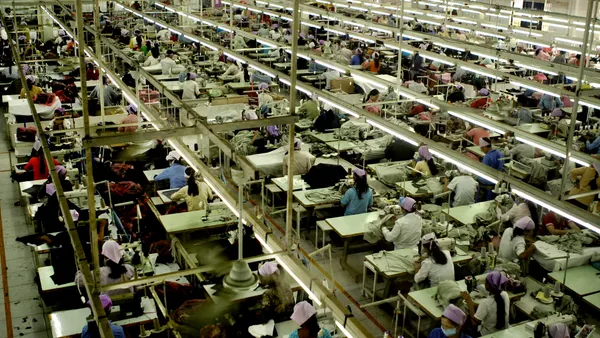
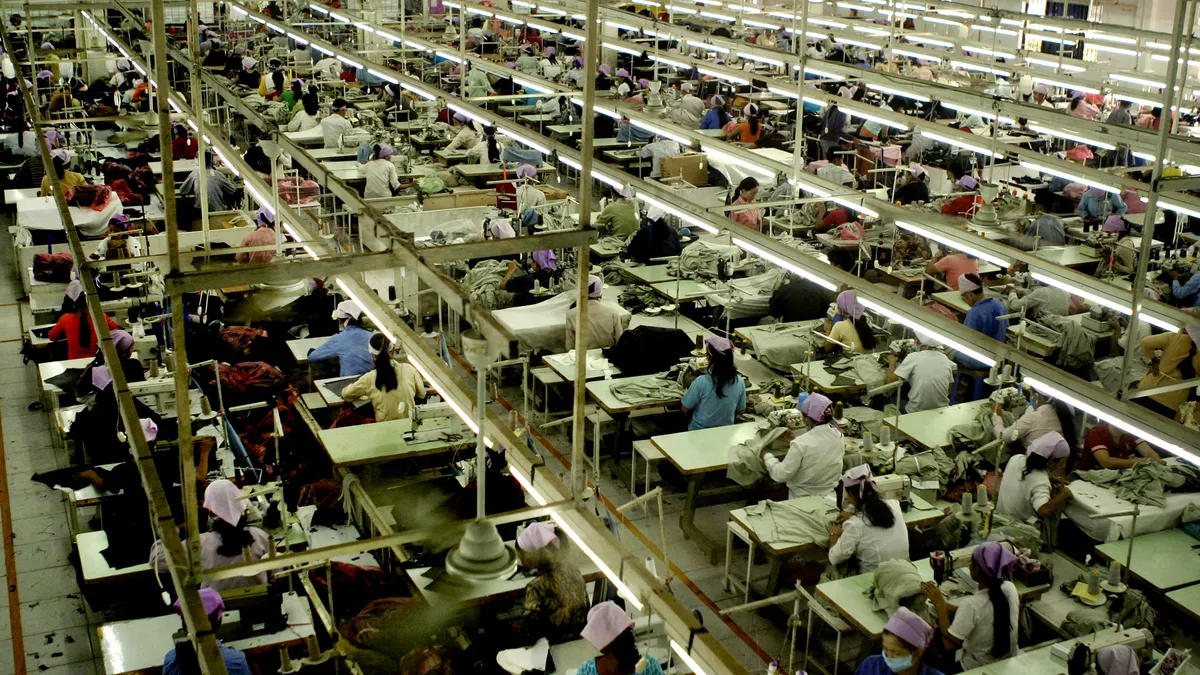
- Garment workers in Bangladesh earn 73% less than the country’s living wage, which the Clean Clothes Campaign describes as a wage that is able to meet the basic needs of a worker and their family, while also providing some discretionary income. Garment workers in Pakistan earn 74% less, while workers in Serbia earn 63% less and workers in Turkey earn 66% less, according to wage data the nonprofit collected independently through worker surveys.
Dive Insight:
Starting in 2029, large fashion companies will be held accountable for the pay structures within their supply chains under the European Union’s Corporate Sustainability Due Diligence Directive. According to the law, companies should also be “responsible for using their influence to contribute to an adequate standard of living in chains of activities,” which includes “a living wage for employees.”
Thirty of the brands included in the project, according to the nonprofit, are expected to fall in scope of the CSDDD, which applies to EU companies with over 5,000 employees and €1.5 billion ($1.77 billion) in revenue and non-EU entities with over €1.5 billion in EU revenue. But the results of the project show that most are “ill-prepared to fulfill their obligations,” the nonprofit said in a press release.
Of the 110 brands surveyed — which include Adidas, Chanel, Nike, Uniqlo and Zara — 32% have “made a public commitment to working towards a living wage for all workers in its supply chain,” but only 3% have “a public time-bound action plan” to do so, the report said.
Only one brand, outdoor and performance apparel maker Devold of Norway, claimed that 50% of its supplier factories pay workers a living wage, the largest percentage claimed by any brand assessed. Three brands — Puma, Zeeman and Schijvens — claimed that between 1% and 25% of supplier factories in the company’s supply chain pay workers a living wage, according to the report. No other brands, including Zara-owner Inditex, Amazon, H&M, Chanel and Adidas, claimed that its suppliers are paying workers a living wage, and there is no public evidence that they are doing so, per the report.
“Since the project began in 2019, we have seen only a 3% improvement on brand living wage scores, with 96% of brands currently failing to provide a living wage to any workers,” Fashion Checker Coordinator Aileen Robinson said in a Sept. 26 press release.
“Most of the largest fashion companies, many of which will fall under the CSDDD, post record profits year-on-year while workers are seeing little or no change to their wages,” Robinson said in an email to ESG Dive.
She pointed to a recent investigation the Clean Clothes Campaign conducted that found that major brands are now paying 30% less, in real terms, for a cotton T-shirt made in Bangladesh than they did 25 years ago.
In addition, 25% of the companies included don’t have a publicly accessible grievance mechanism that workers can use to report concerns, including wage violations, the September report found.
Despite the report’s findings, H&M Group Global Press Officer Pernille Skanvig Schønau told ESG Dive that the clothing brand’s suppliers pay “a gross wage average in many countries” that is “higher than the minimum wage,” and pointed to the company’s public-facing wage data. However, on the same page, H&M notes that, “in some cases, the minimum wage is not enough to meet basic needs for workers.”
H&M is a member of ACT Cambodia, an agreement between trade unions and brands, Skanvig Schønau said in emailed comments, noting the company’s involvement has “recently resulted in a binding agreement with IndustriALL Global Union in Cambodia, supporting collectively bargained wages and improved working conditions in the garment, textile, footwear and travel goods industry.”
“We believe the Fashion Checker does not provide an accurate picture of our work,” Skanvig Schønau added.
According to H&M’s wage data, the “Gross Average Wage” in Bangladesh is 18,000 taka (about $164 at current exchange rates) a month, but “a living wage would be 30,000 taka,” (about $244), Paul Roeland, transparency coordinator at Clean Clothes Campaign, told ESG Dive, referencing the benchmarks established by independent nonprofit Wage Indicator. Roeland said that H&M should also define “Gross Average Wage,” because that could include overtime.
“From recent on-the-ground research that we did in Bangladesh, we know that indeed many workers do overtime to make ends meet,” Roeland said in emailed comments. “That is however not how a living wage is defined. That should be earned in a normal work week.”
The ACT agreement H&M mentioned has led “to a measly USD 6 monthly increase in Cambodia, in just a few factories,” Roeland added. “H&M (and, to be fair, other brands as well) often hide behind a few token initiatives, pilot projects, roadmaps etcetera without real-world impact.”