Dive Brief:
- New York State is set to make significant changes to its climate goals and emission reduction deadlines as part of sweeping reforms outlined in its 2027 budget.
- Gov. Kathy Hochul announced last week she had reached an agreement with state legislators on a $268 billion budget that will roll back key elements of New York’s 2019 Climate Leadership and Community Protection Act to help drive down rising energy costs. The law mandates statewide emissions reductions and a transition to clean energy.
- Proposed changes to the CLCPA include scrapping a goal that requires a 40% reduction in greenhouse gas emissions by 2030, compared to 1990 levels, and replacing it with a target that seeks a 60% reduction in emissions by 2040. The new budget agreement also seeks to revise the accounting standard New York State uses to measure its emissions impact, updating the timeframe from 20 years to 100 years to match other national and global jurisdictions.
Dive Insight:
New York will be required to promulgate regulations by 2028 that keep it on track to meet the new decarbonization mandates, Hochul said in the May 7 presentation outlining the budget agreement. The budget, originally due April 1, has yet to pass.
The governor’s office confirmed the changes to ESG Dive Wednesday, noting that the budget also amends the CLCPA to ensure that the new regulations still aim to achieve the state’s 2050 emissions reduction mandate. The original climate law requires New York State to cut its emissions by 85% by 2050, compared to a 1990 baseline.
The CLCPA will also be updated to increase funding for disadvantaged communities, Hochul’s office said. These communities will now receive 40% of the benefits of investment funding set aside to meet climate goals, up from 35%.
The New York governor’s office said in an emailed statement that the budget will “avert the threat of major consumer cost increases,” while “continuing the state’s commitment to clean energy and climate.”
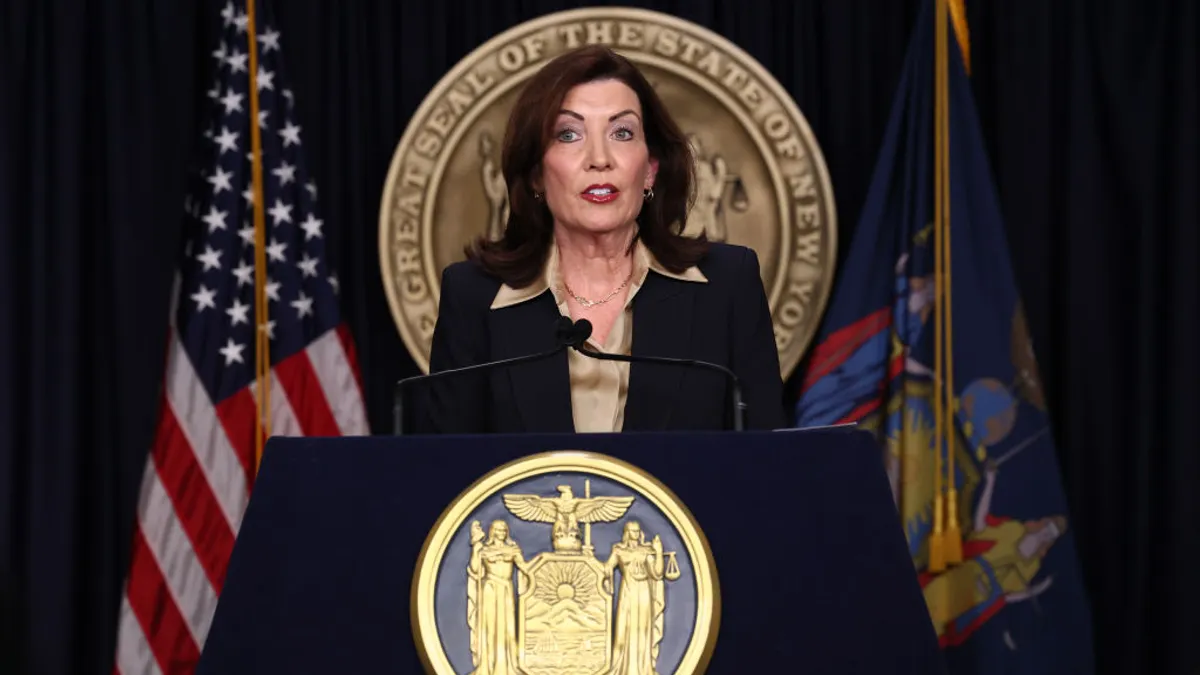
Hochul mirrored this sentiment in her opening remarks outlining the budget last week.
“I've been candid about the Climate Leadership and Community Protection Act,” Hochul said. “New York has led, and will continue to lead, on clean energy and climate. But reality has been harsh: We cannot meet the current timelines without driving energy costs higher.”
Hochul added that the state has to “strike the right balance between [its] clean energy ambitions and the affordability pressures that real New Yorkers are facing right now.”
The Democratic governor has been in favor of rolling back the state’s climate law for some time. Earlier this year, Hochul told attendees at a Politico summit that New York needed some “breathing room” to meet the targets mapped out under the CLCPA. The law includes goals to meet 70% of the state’s electricity needs through renewable energy by 2030 and to have 100% zero-emissions electricity by 2040.
New York’s ambitious sustainability goals have been impacted by a myriad of factors, Hochul said during the March summit, including the COVID-19 pandemic, the offshore wind industry’s ongoing financial struggles since 2020, President Donald Trump’s opposition to renewable energy and the ongoing energy affordability crisis.
At the time, Hochul said the state’s ongoing budget talks were likely the “best vehicle” for modifying the 2019 law.
Amid the governor’s bid to tone down the state’s climate and sustainability aspirations to cut costs, New York has simultaneously been working to introduce laws that aim to accelerate decarbonization across the state and hold companies accountable for their carbon footprint.
In February, The New York State Senate passed the Climate Corporate Data Accountability Act — or Senate Bill 9072A — requires entities who do business or derive receipts from business activities in the Empire State and generate over $1 billion in revenue in the prior fiscal year to annually disclose their direct and indirect greenhouse gas emissions. The bill complemented eight other pieces of legislation that were greenlit the same day, including bills that aim to reduce industrial pollution, limit interference with emission control devices, and prohibit the sale of consumer goods containing toxic chemicals.
In December, the state also passed a law requiring large emitters to disclose their emissions. This is the first year facilities generating 10,000 or more metric tons of carbon dioxide equivalent annually will be required to collect data.
Editor’s note: This story has been updated to include Gov. Hochul’s comments at the March Politico summit.